Taking the Train from Bukhara to Khiva
From Bukhara, we boarded another train to what would be our furthest point west in Central Asia and what was undoubtedly our favorite stop on the Silk Road…Khiva. Unlike the last, this train only offered sleeper bed seats making it a much more cozy experience for the duration of our six hours. Uzbekistan definitely deserves high points for its train travel…(so long as you remember to book in advance!)


After a 30-minute $2 Yandex taxi ride from our guesthouse to the train station at 5:30 a.m., we arrived to a mostly desolate train station one hour before departure.
Yes, we know one hour seems extreme at this hour, but we now have a rule to plan to arrive one hour before buses or trains depart due to issues in the past, mostly with securing taxis at an early hour, causing too much last minute anxiety. Fortunately that wasn’t the case this time.
Although this station, unlike the one in Samarkand, had an arrivals and departure board, it made absolutely no sense with the scrambled times listed when compared to the tickets we had in our hand. This was even after confirming all the words with Google. Uh, well, at least they tried? Luckily, everyone in the station, which would soon grow immensely, was going to the same place…at the same time…

Also, unlike our experience in Samarkand, the train arrived right one time, just as the sun was beginning to dazzle the horizon.
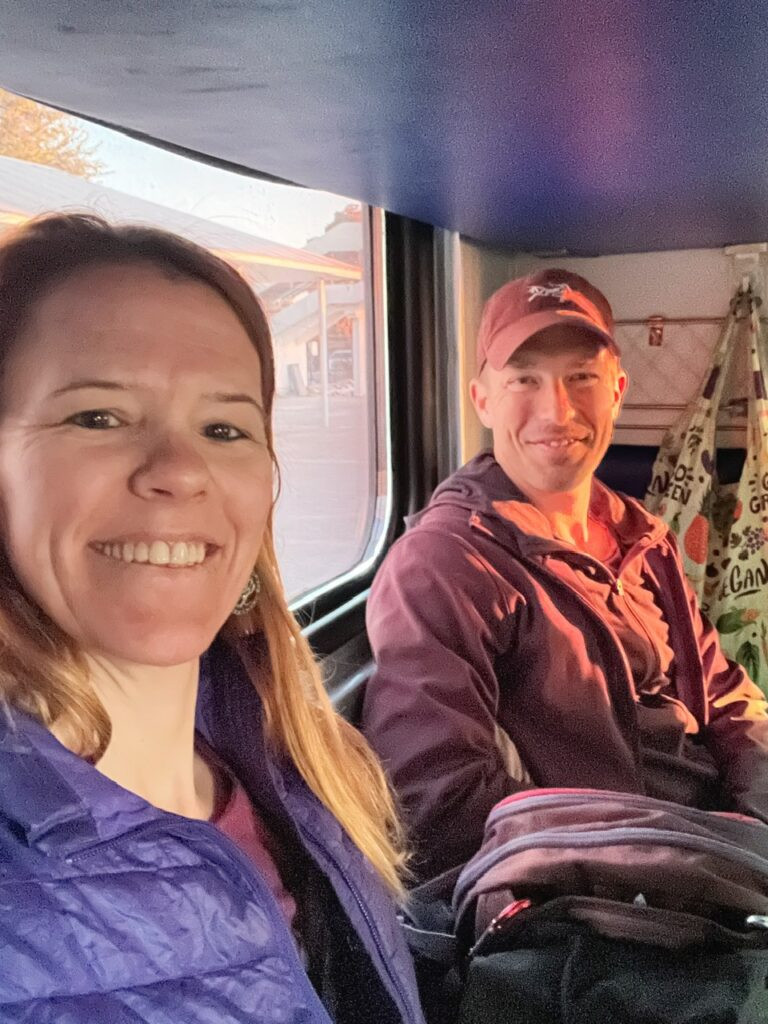


Photo 1: The train was laid out in an interesting format with pods of four sleepers & a table on one side, and two sleepers, top and bottom on the other. There was a big gap near the ceiling for our backpacks. After rousing a lady who was completely zonked out in Mandy’s top bunk, and enlisting the help of a nearby local to help us communicate the issue, we slid into our bottom compartment and sat sofa style.
Photo 2: The kind local across from us who helped us kick out Sleeping Beauty.
Photo 3: We then assembled our padded beds using the plastic package of goodies lying on each seat. Included was what appeared to be a quite clean and pressed pillow case, which would soon envelop a surprisingly fluffy pillow, a top and bottom sheet, and a towel…


….not that we suspected we’d be doing any showering here. But a far, far cry from the worst train toilets we’ve ever seen! (Ugh…India) It didn’t take long for everyone to get into position…


….which required a whole lot more flexibility and maneuvering for the one on top. Now this is traveling!! They also sold snacks throughout the morning, although we brought our own. We’ll take this over a bus or marshrutka any day!
Later on in our journey, I looked at Google Maps, which astonishingly worked in…what? Turkmenistan?! Ummm…we definitely need a visa…a guide…and lots of money to be in that country! Fortunately, Greg informed me, this is just a known Google error. The map hasn’t been updated since the new Uzbek line was built around 2016. To Khiva we go…
Qibla Tozabog: Maybe the Most Amusing Place We’ve Ever Stayed
We were thrilled to learn that our hotel, Qibla Tozabog, in Khiva would be picking us up by FREE shuttle once we arrived to the station, a service shockingly not often included in our meagre hotel budget. This is the same shuttle that would be available at our beck and call should we want to roll to the historic center of Khiva, rather than use our feet for 25 minutes. In fact, the hospitality at this hotel was the best we’ve experienced in Central Asia for a quite affordable price of $31/night. And the decor….well, it was also something alright.


It started when we glided in the hotel on a crimson carpet huffing our still dirty backpacks from the Pamir Highway, and were greeted with a blend of Central Asia meets Victorian meets the tropics (which we’re obviously nowhere near…)
This intensified about ten notches when we arrived to our double-room, which was grand enough to do two cartwheels across its casino-red dusted carpet. All it needed was some penny slots to complete the look. Needless to say, spreading out for workouts would finally not be a problem in this room. (And yes, for those curious, the camera is on the regular, not wide-lens setting.)
Of course, the carpet was just part of the amusingly nauseating arrangement of colors and furnishings cast into this chamber. The stone hard mattress, which we confirmed was (another) box spring with a pad on top, was accessorized with a cascade of bling…from the bejeweled headboard to the polyester comforter, which any of my Barbies in the mid-80s would have been elated to sleep under.
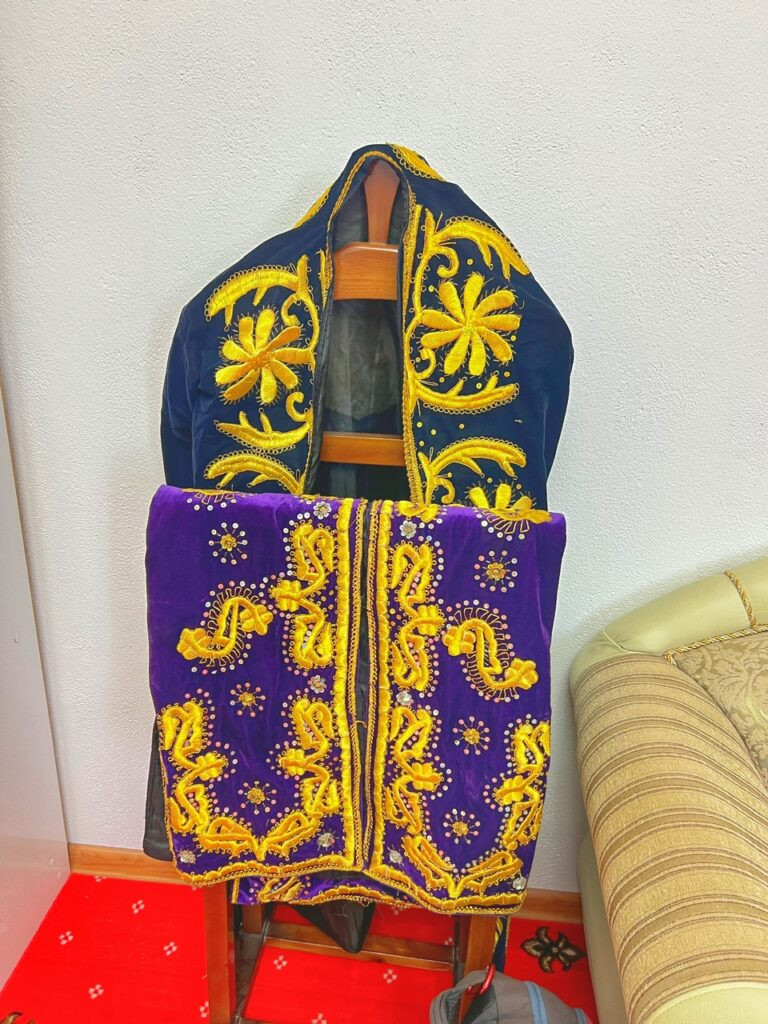

This, of course, brings me to Barbie’s wardrobe….Uzbek-style. And a sink clearly made for a pink princess. But if you find this appealing….

…wait til the camera pans out and you see the whole engaging ensemble.


There is so much going on here. Are we in Paris? Or Vegas? Or Uzbekistan? And from what era? All this said, even though our sofa was gaudily adorned, we were delighted to have a ginormous room with multiple places to sit, a tea kettle and a fridge for the first time in weeks.

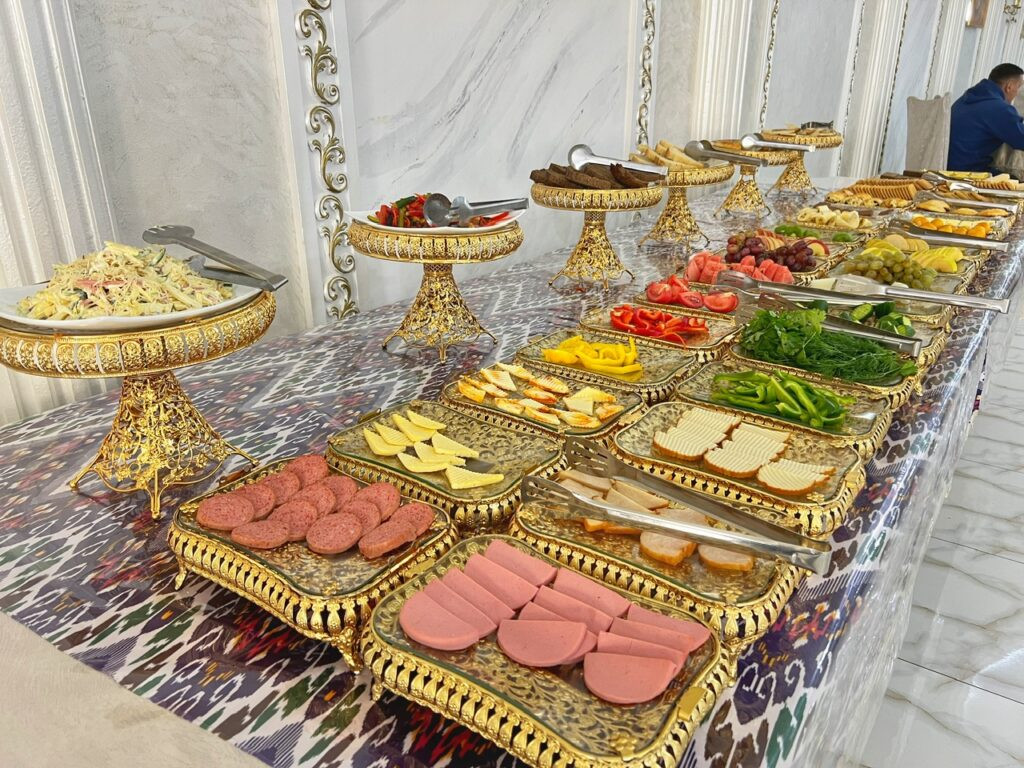
But the real icing on this time capsule cake was the impeccably embellished event venue, complete with “gold” flaked sweeping chandeliers made of Swarovski Chinese plastic, towers of synthetic flowers, a pastel-ed leaf accented stage backdrop, (which looked exactly like earrings my mom had in 1988), and metallic photo curtains à la 1986.

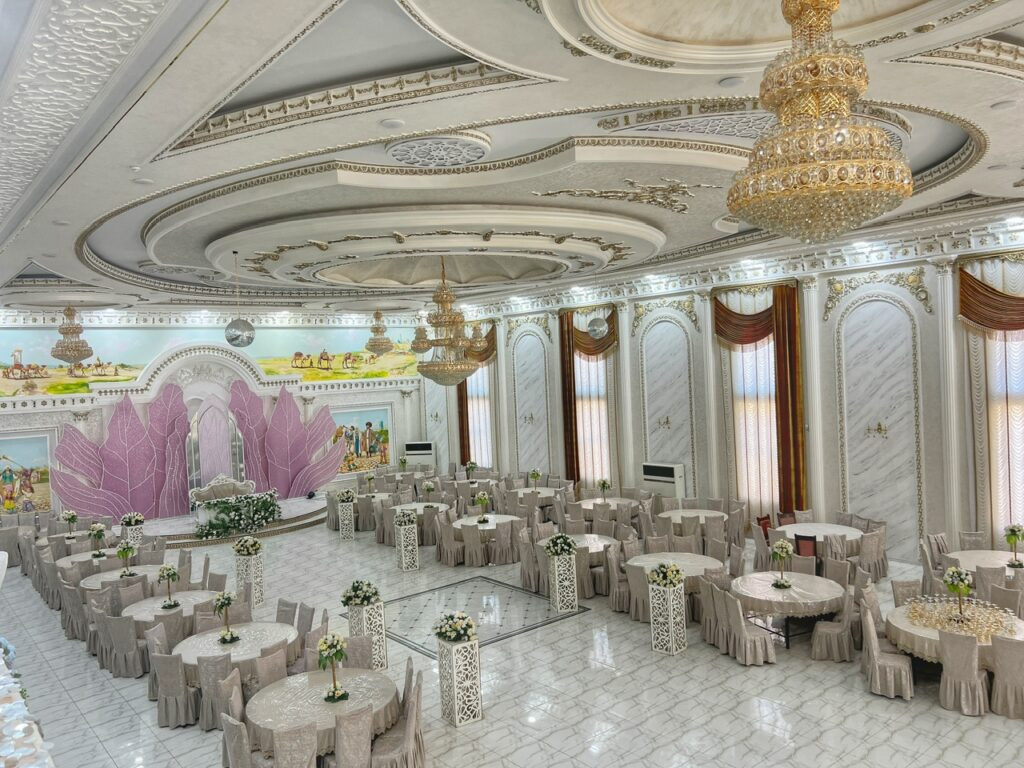
My inner child princess wanted to utter exclamations of awe and glee, while entering the room in an obscenely fluffy pink dress, while my former professional Event Coordinator experience wanted to compose various faces of anxiety and trauma.
The balcony view from where we’d have our buffet breakfast while listening to the somber sounds of Beethoven’s “Moonlight Sonata,” arguably the most suicidal of all his tracks.
Yes, I may be doing a lot of fun-poking…but we loved it. Plus, this buffet, the shuttle and the service definitely made the stay worthwhile…

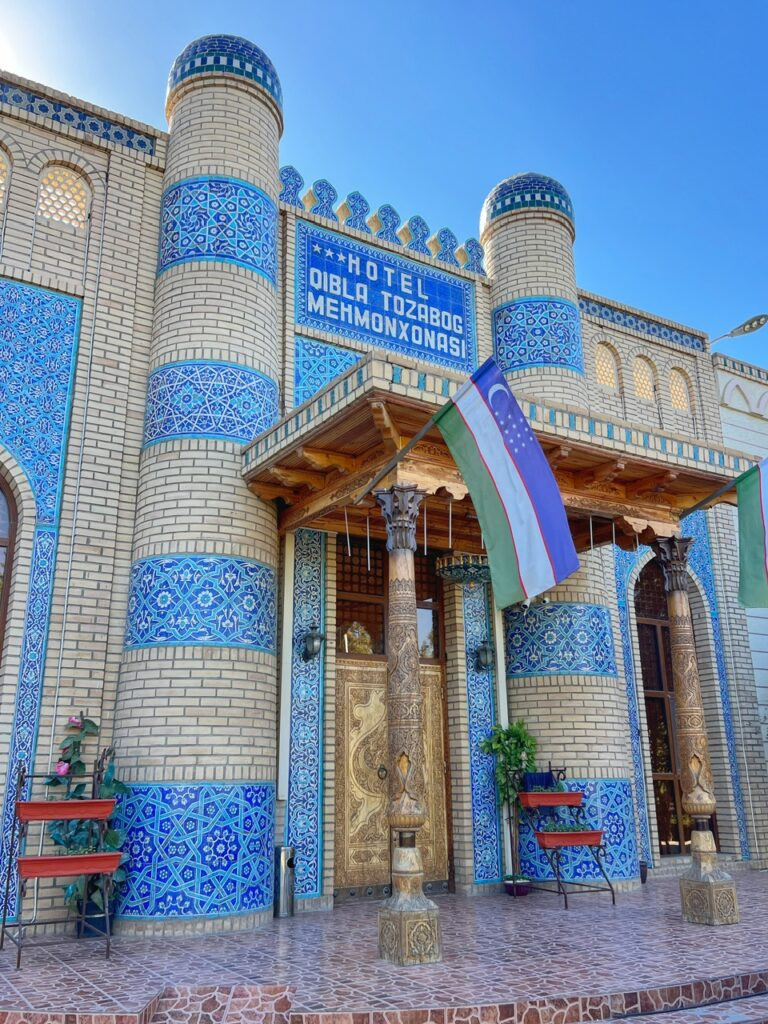
In addition….there was one more thing I needed to do before we left….
Exploring Itchan Kala Fortress City
Our final and most favored stop on Uzbekistan’s Silk Road took us to the legendary lair of Khiva, home to the first 1990 UNESCO site in the country….an immaculately preserved fortress city called Itchan Kala, which showcases one of the most intact examples of medieval Central Asia. Treading into its compact and quiet inner city walls is like stepping centuries back in time.
Many travelers liken it to a living museum, while others say it has been Disneyfied. With its polished, clean and mostly pedestrian-only streets, it certainly has some Disney elements, but for us, felt visually magical…but also authentic. It’s much more excellently executed history than a theme park, and the affordability also wins high awards. That said, for us….it was absolutely worth the effort to get to.


All this said, the absolute best activity within Khiva was to wander away from the crowds, which never felt too crazy late in the day, and simply roam this charismatic slice of history.
The most remarkable icon of the city is the mosaic masterpiece of Kalta Minor Minaret, which today looks more like a ravishing whacked-up water tower coated in dazzling turquoise tiles.
In the mid-1800s, it was meant to be over 70 meters tall, making it the tallest in Central Asia at the time. Today it stands only 29 meters because it was never finished when the Khan who commissioned it died. Even at this height, it’s quite a showpiece…
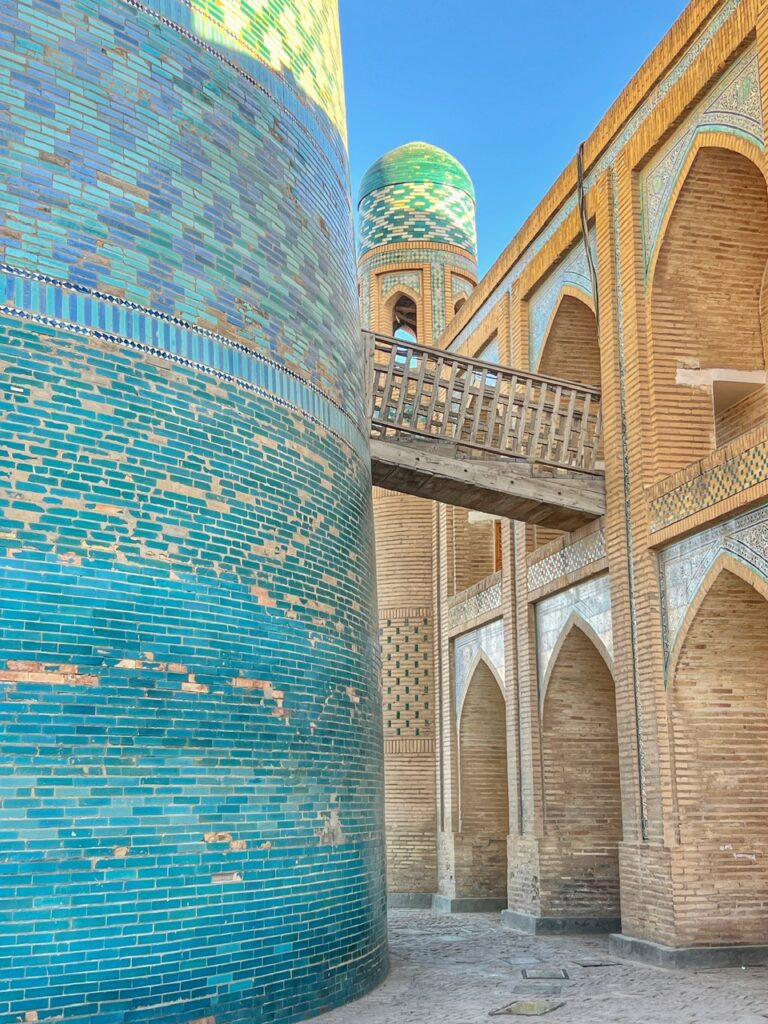
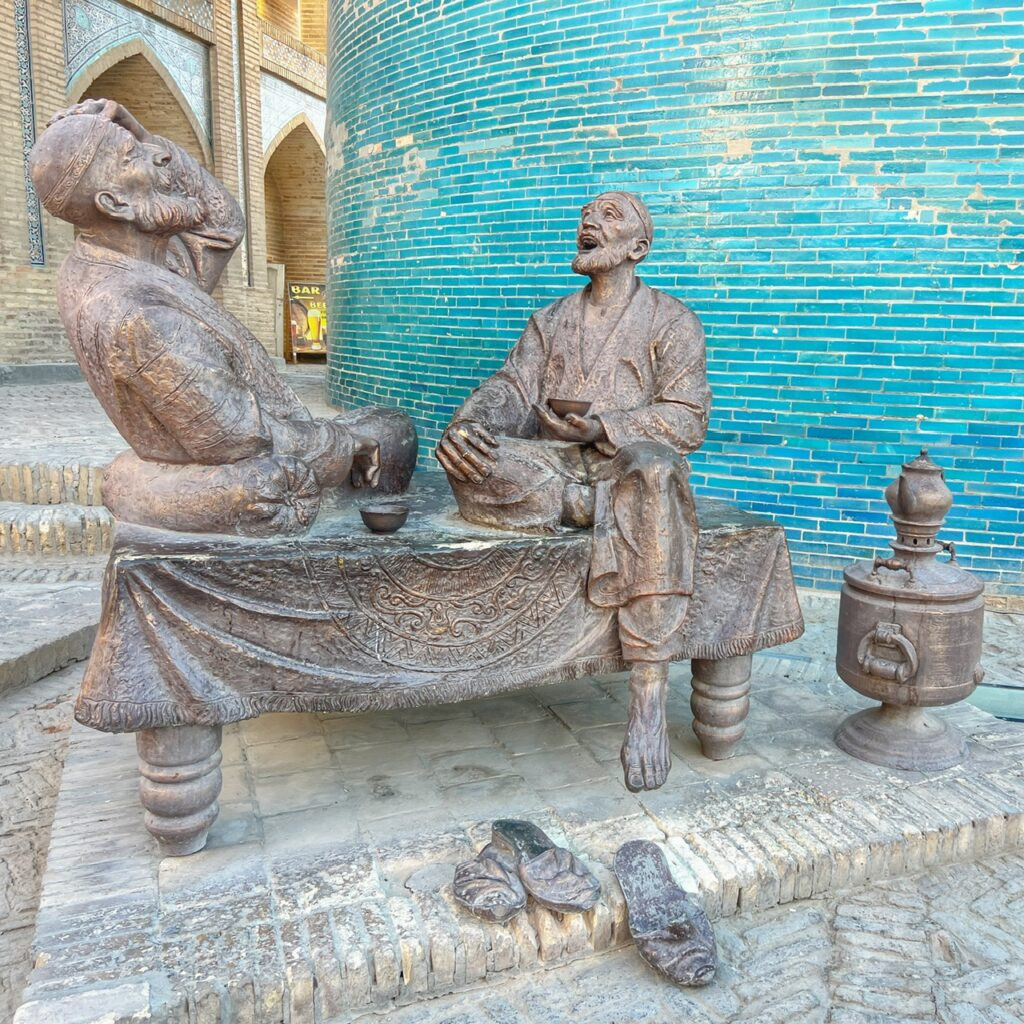
….and here you can check out its girth as well. A bronzed statue in front of it signifies two symbolic townsmen, laughing over tea. They represent Uzbek chaykhana (tea house) culture, a vital part of daily life in Central Asia, where men gather to drink green tea, gossip, debate, or exchange jokes. We loved the details in this piece including the kicked-off slippers on the ground, which is traditionally done when joining an Uzbek table, and the token, small squat teacups that look like bowls.


With its glittering green dome, the Pahlavan Mahmud Mausoleum is the most sacred site in Khiva. According to Chat, Mahmud was a poet, philosopher….wrestler….(?) and Khiva’s patron saint.


If you’re planning a trip to Khiva, one important thing to note…there is supposedly an entry fee just to walk around the walled city and take pictures, even if you don’t go to a museum, or site. This is a bit ridiculous considering the number of restaurants, shopping, and hotels inside, and the fact we were visiting for three days (on the outside of the wall). However, we discovered if you enter via the north or south gates, you don’t have to pay this fee. This system is a bit dubious, along with many other facets we realized about Uzbekistan.
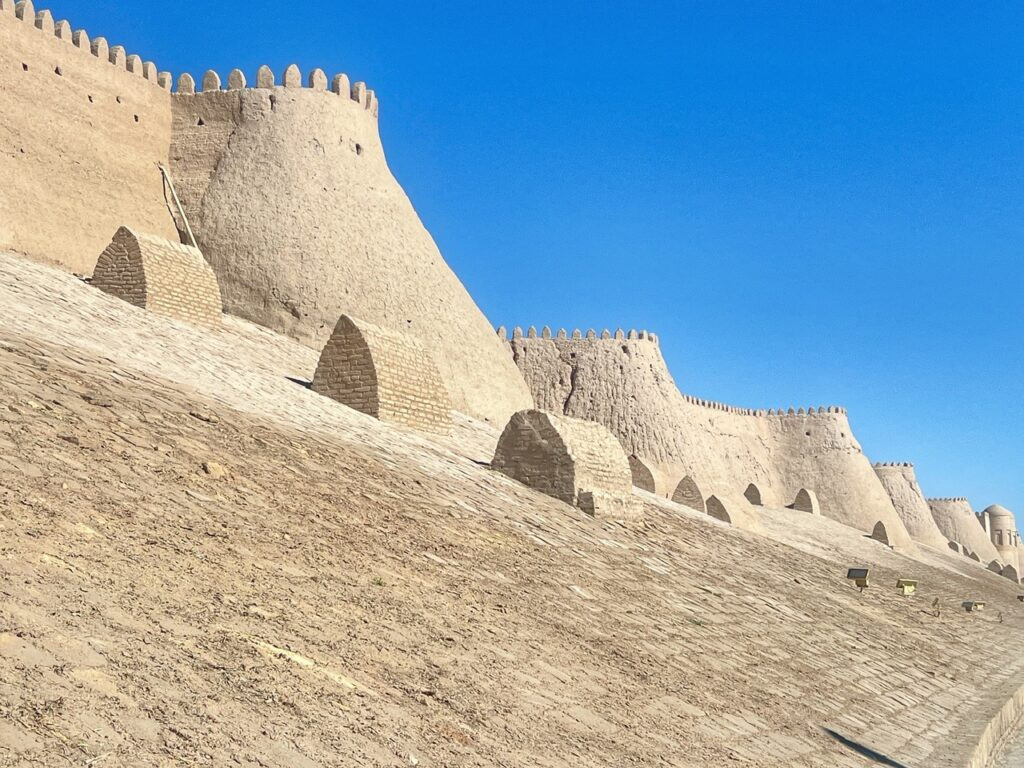

Numbers of tombs line the walls of the city. What bizarre storage techniques… These are all near the South Gate.
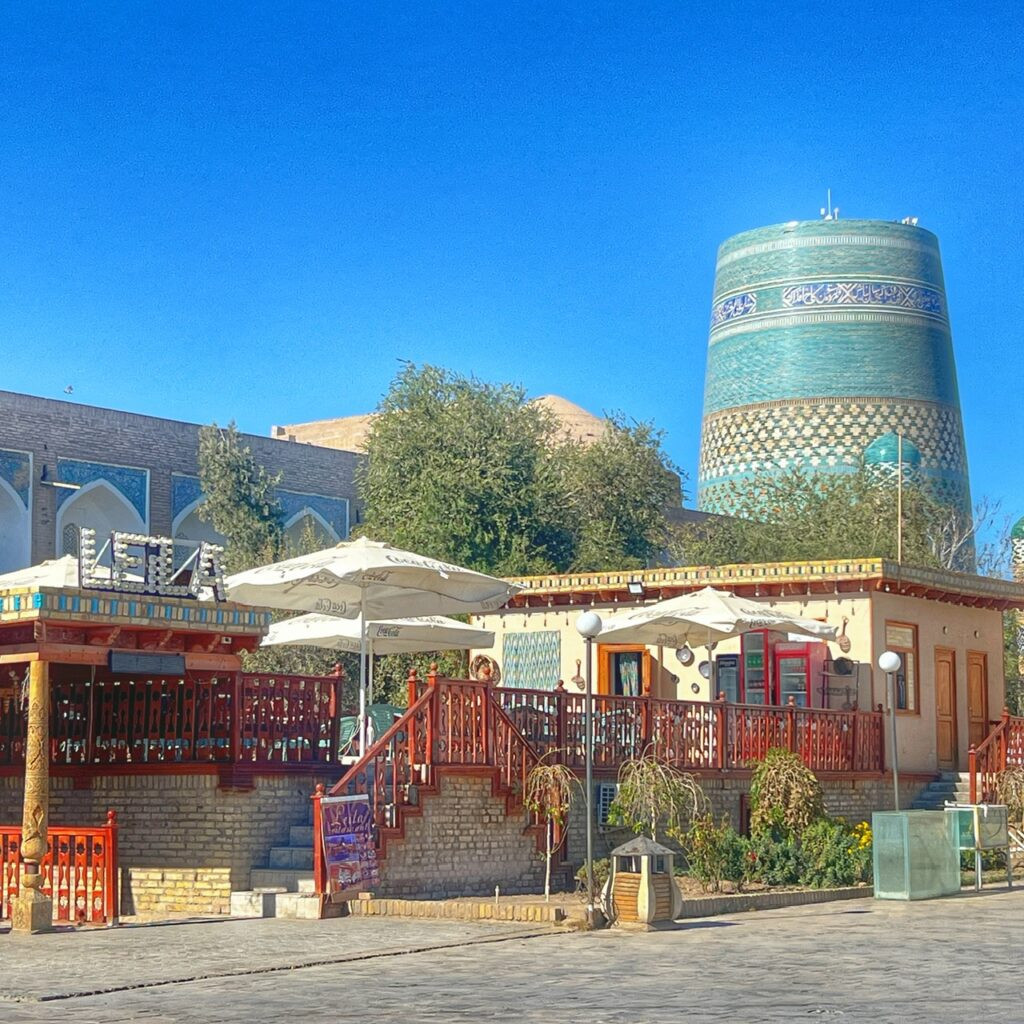
Leila Restaurant where were had two chicken kebabs and pumpkin manti on our last day for $7 total.
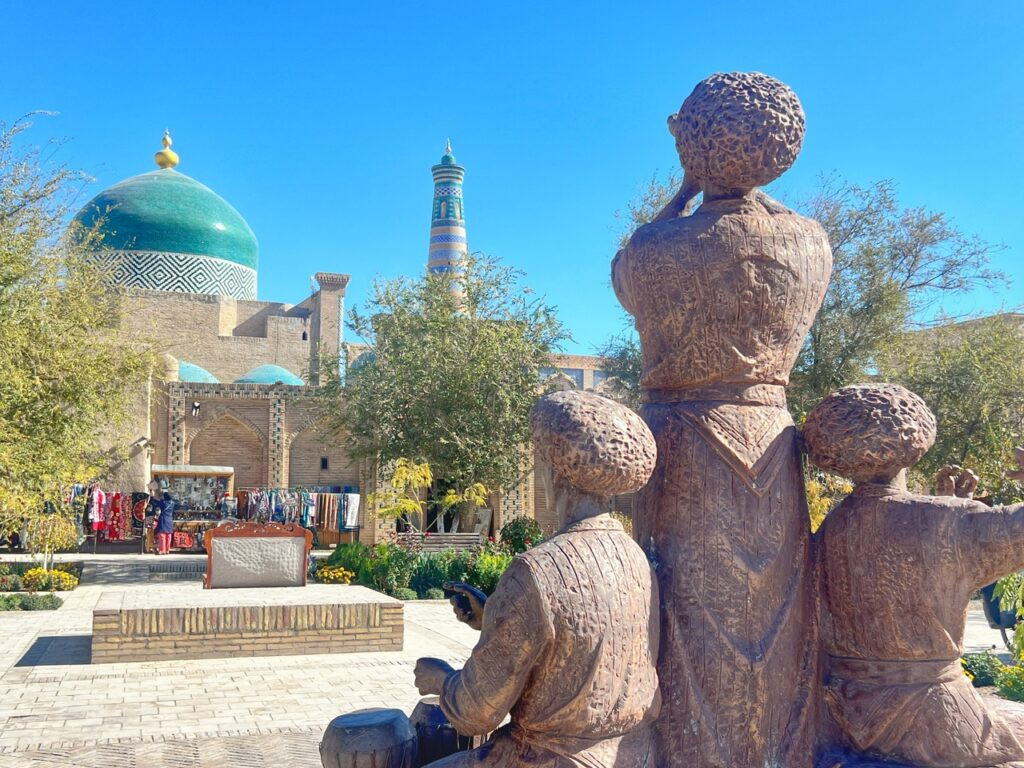
Another statue in front of emerald dome of Pahlavan Mahmud Mausoleum represents an elder man, who is explaining the significance of the saint to the three young boys. It captures a sense of spiritual respect and curiosity.


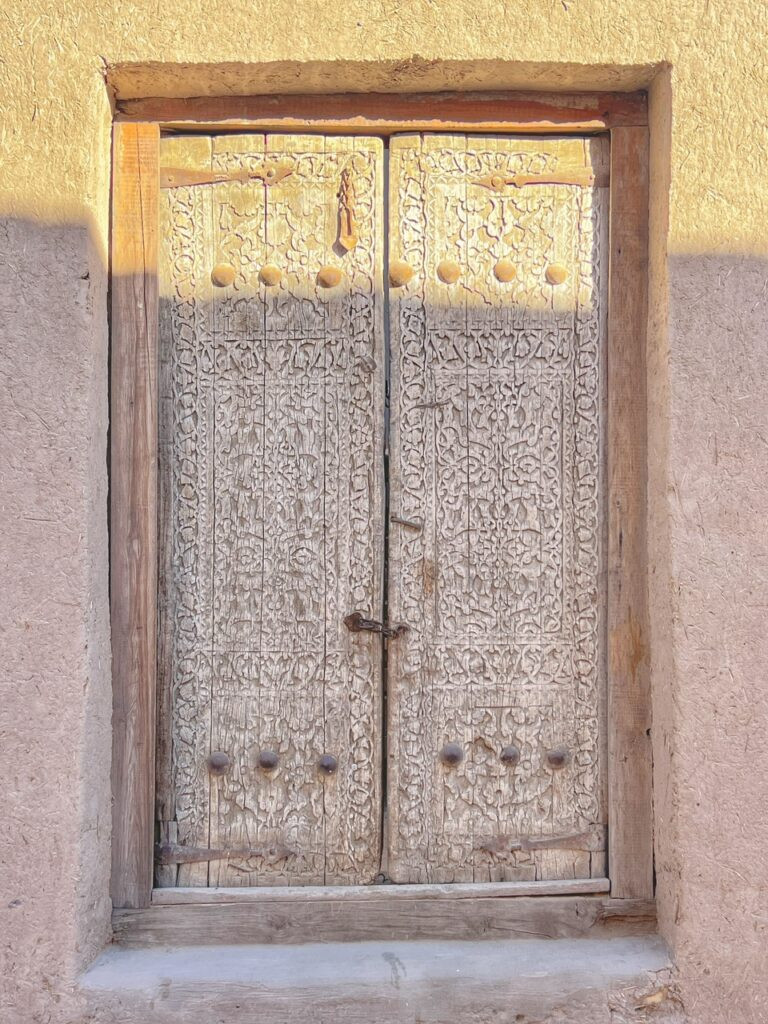
Other pops of wonder
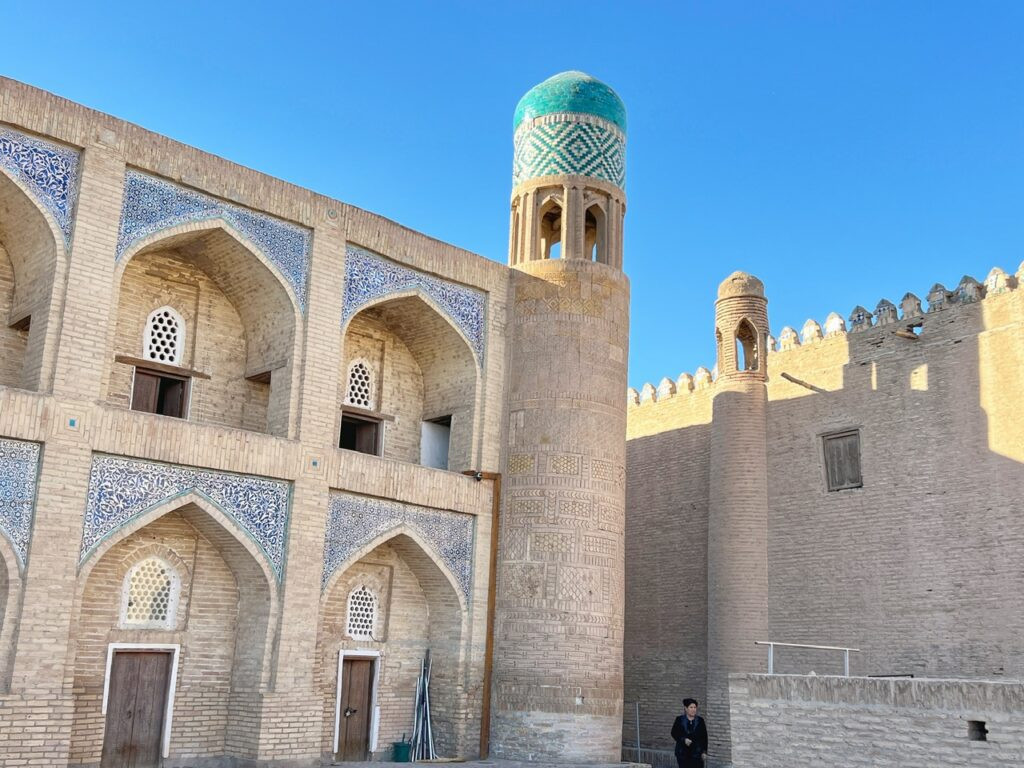
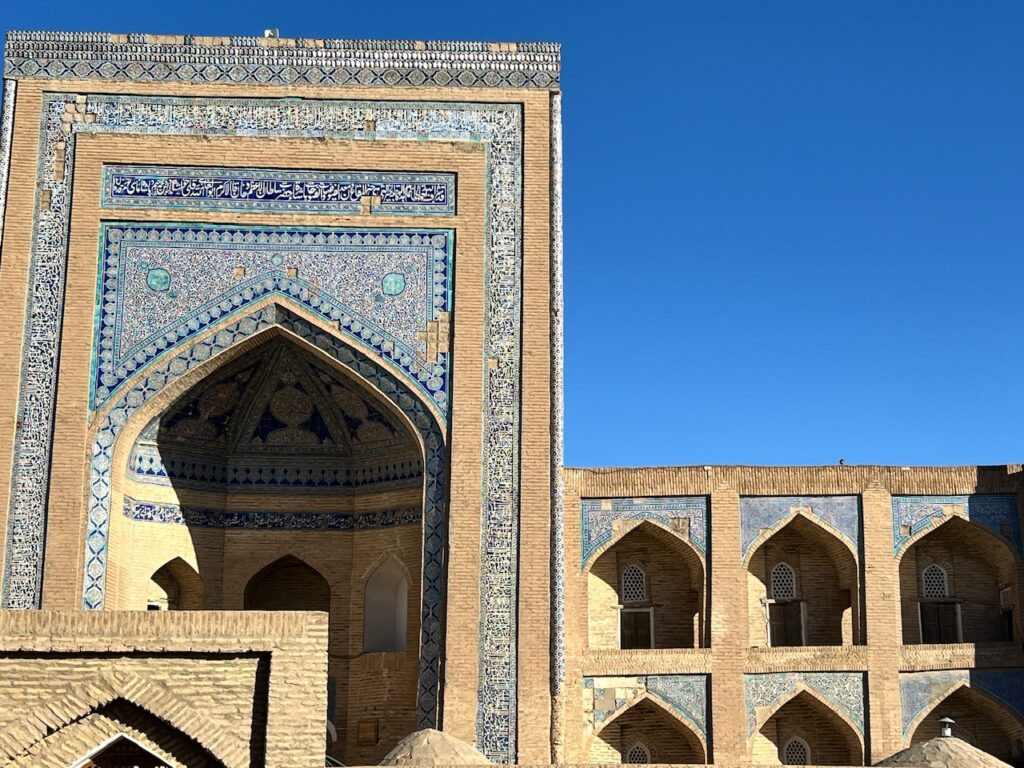

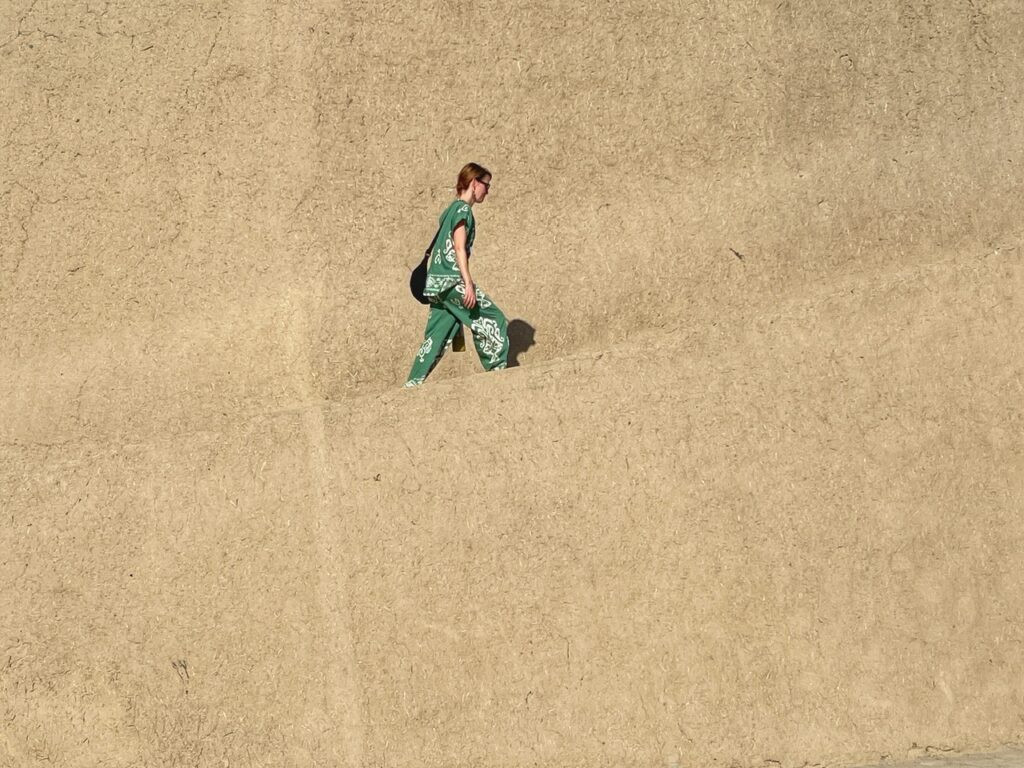
Mandy climbing a small accessible part of the city walls near the north gate.
There is another famed minaret known as Islam Khoja Minaret at 45-meters tall. It is possible to climb it, which we tried to do, by just paying around 20,000 som ( ~$1.60) on the spot, which we read online you could do. Unfortunately, there was no one at the ticket booth, and the guy standing there said we had to go buy a museum pass, which we wouldn’t do, which seems to be more questionable pricing structures.

All this said, we just admired her from the base.
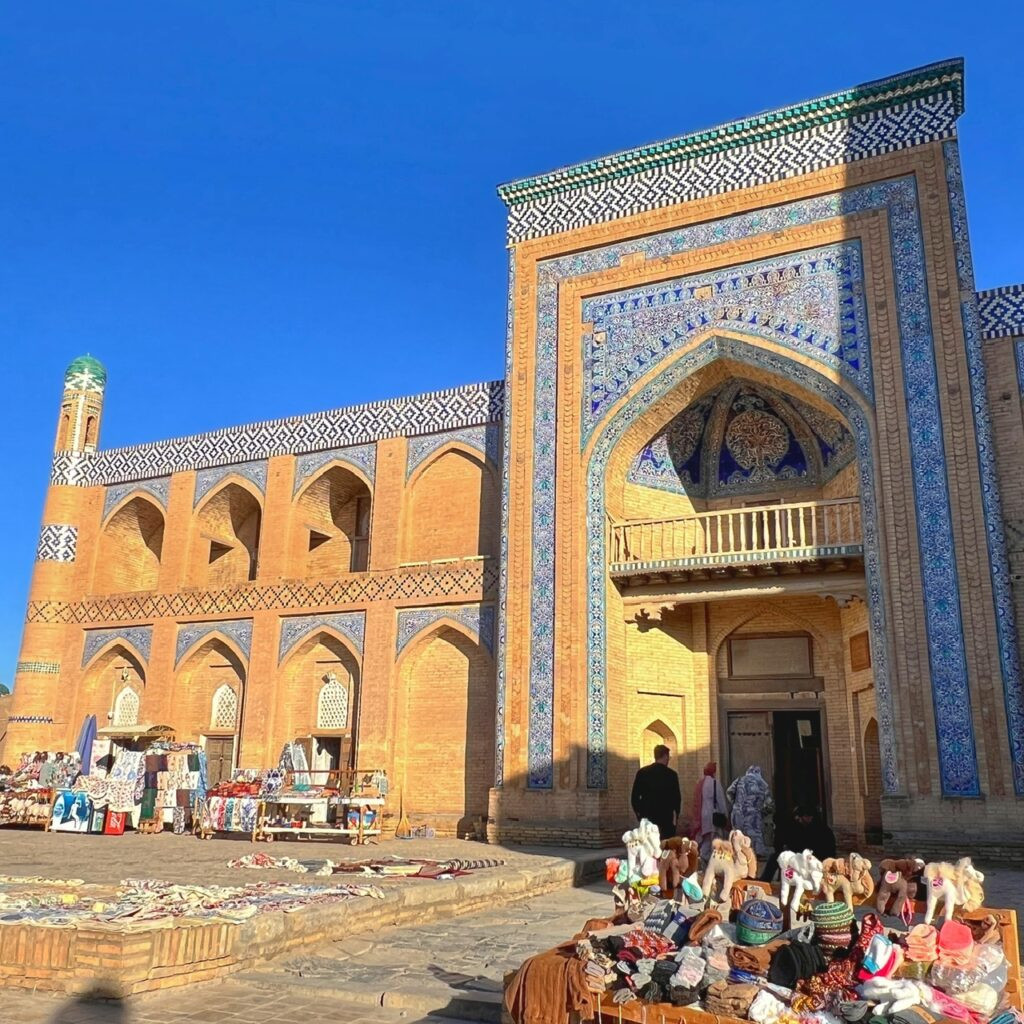
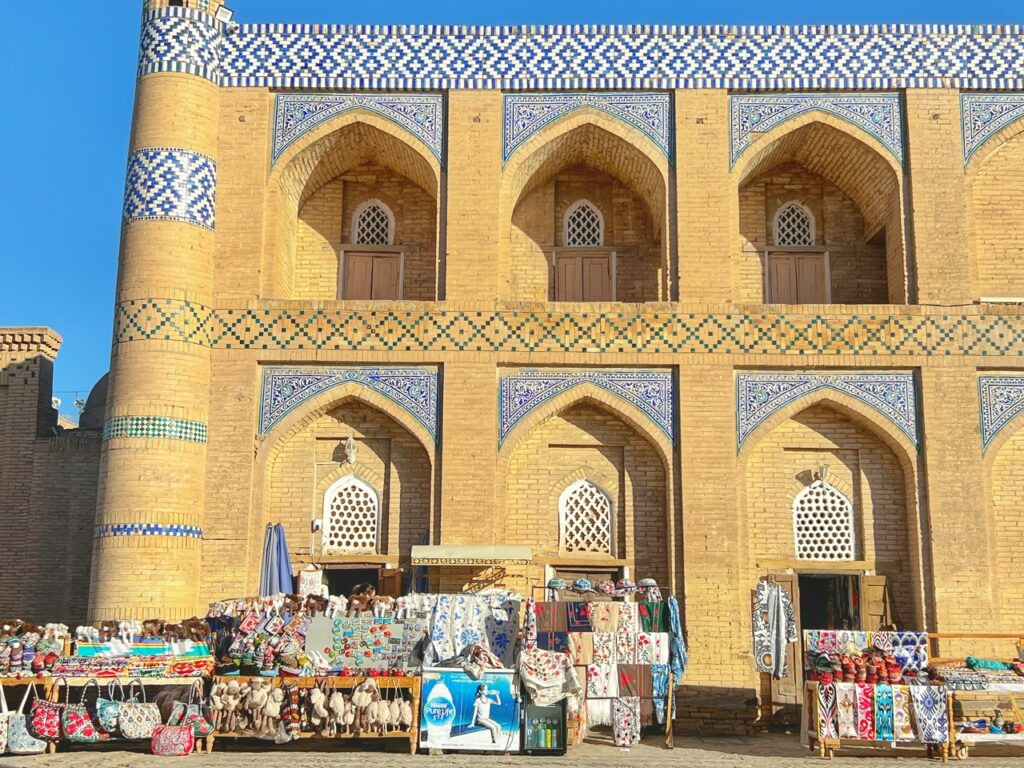
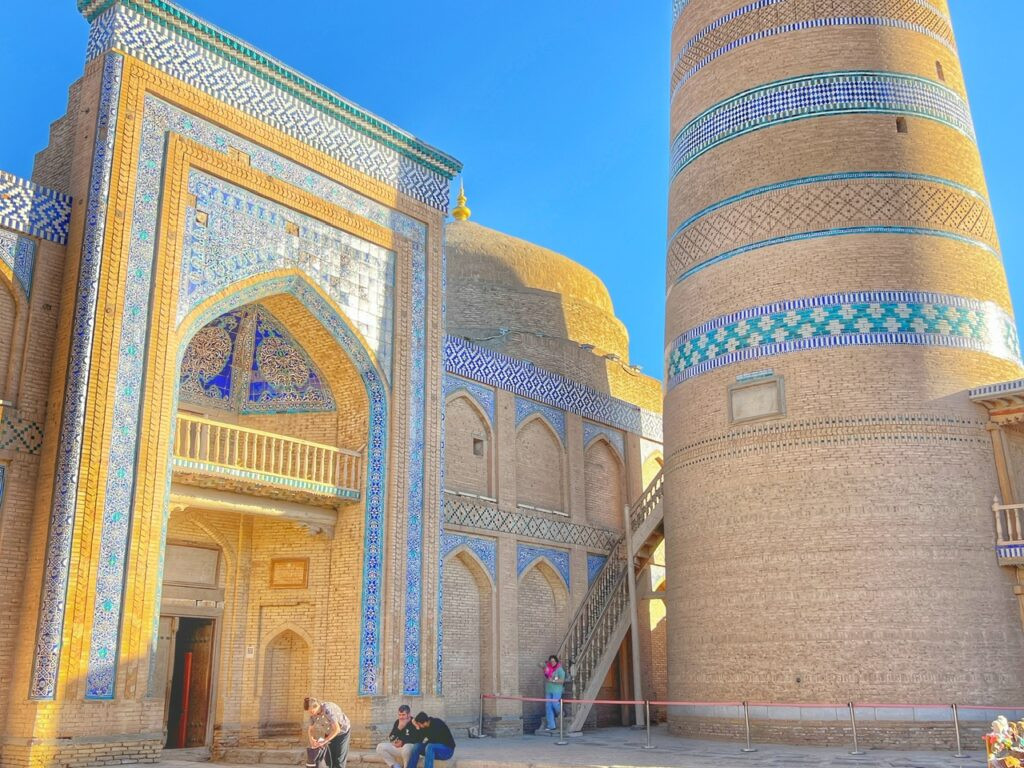
Basking in the late afternoon sunshine instead.
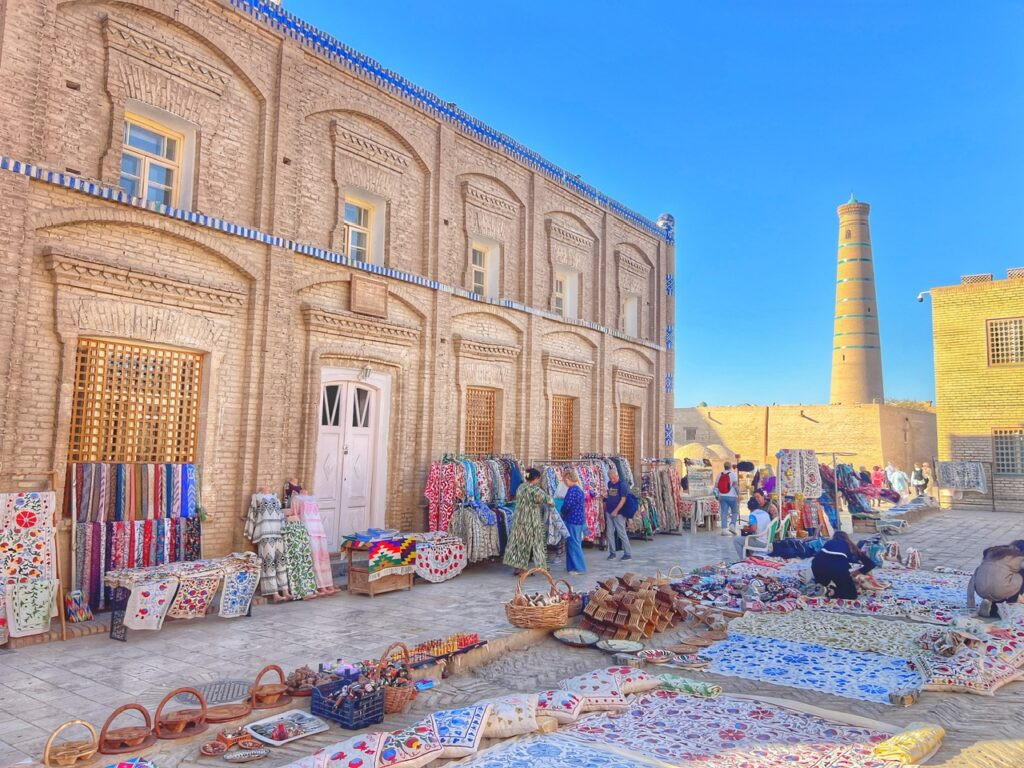
Another former madrasa turned into a souvenir shop…or very quality yard sale.
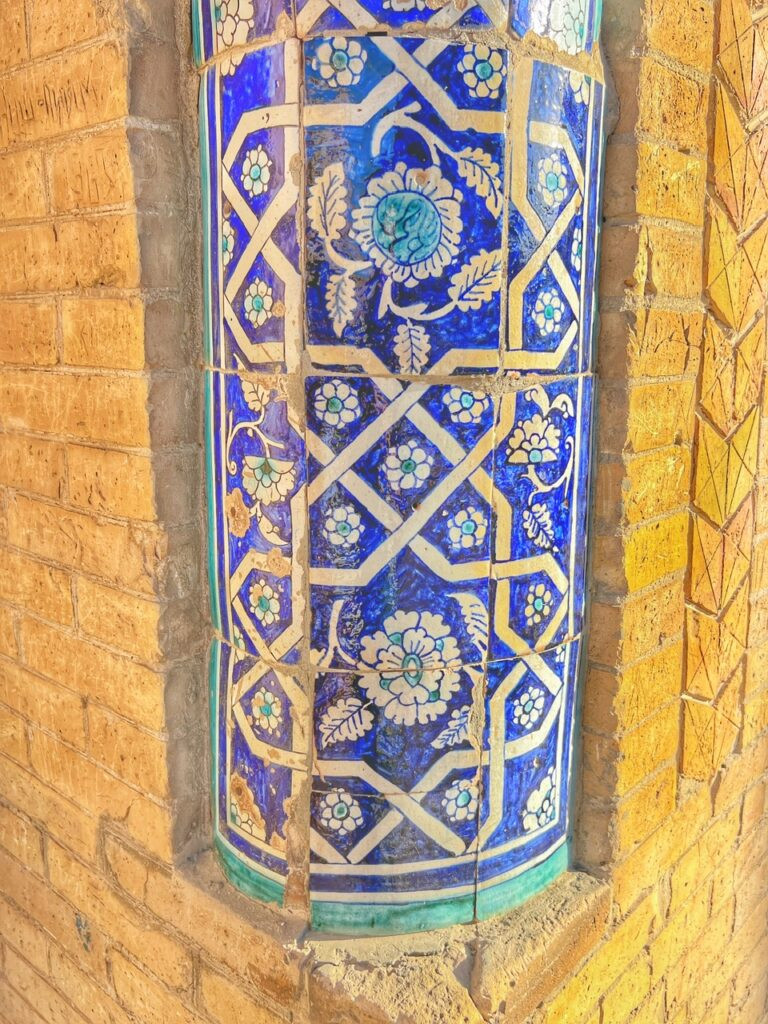
Architecturally, we liked Khiva also because it was a perfect blend of Samarkand’s mosaics and Bukara’s baked brick.
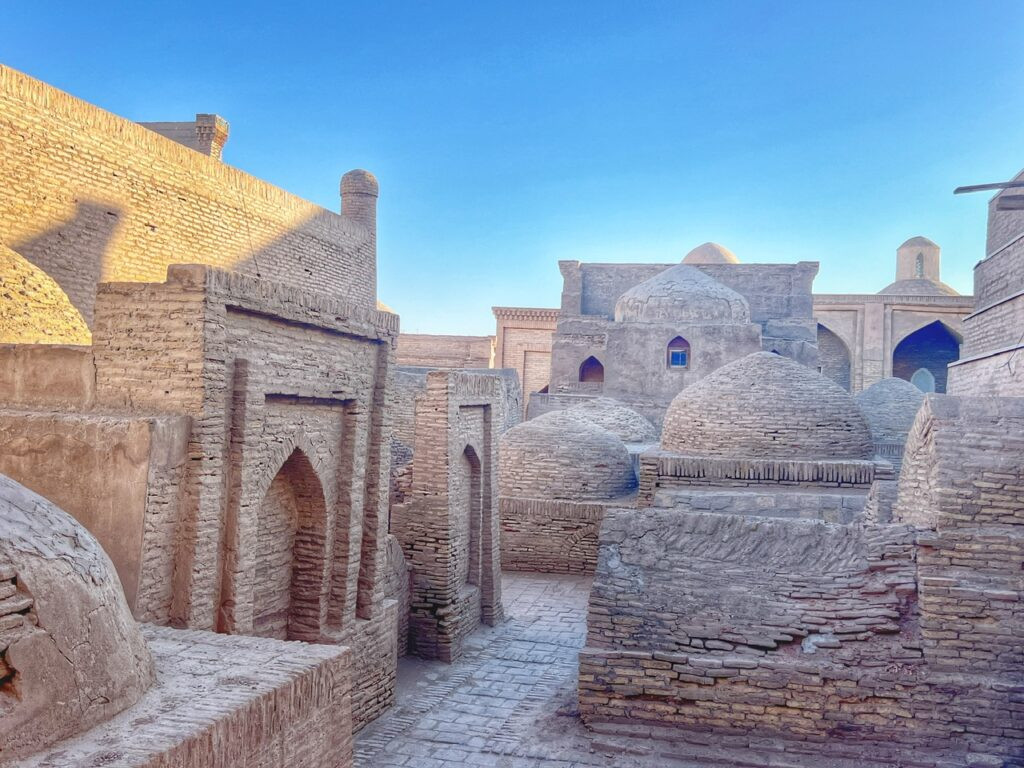
Inside of the Pahlavan Mahmud Mausoleum “graveyard.”

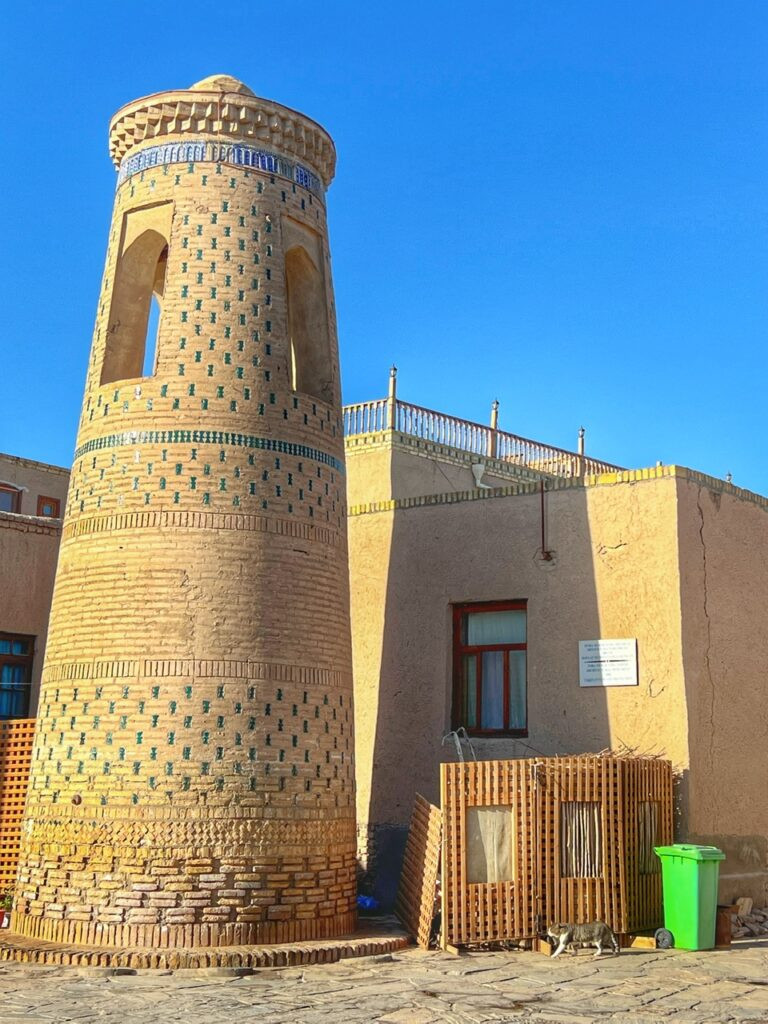
Another view of the Khodja Minaret and a Mini-ret.

Beautiful backdrops everywhere…


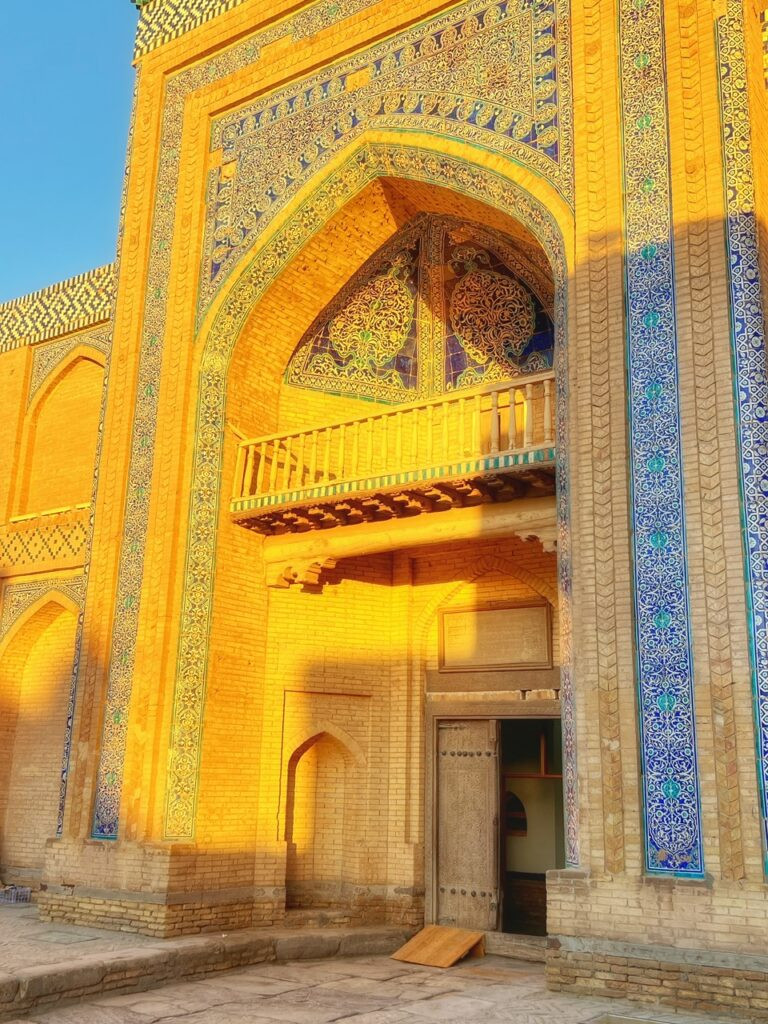
And then the real magic happens as you move into golden hour…

Another day which was much hazier. Hazy and dry air is an unfortunate reality of traveling this part of the world.
Daily Life in Khiva
In addition to walking amongst its superbly preserved ancient ruins, Khiva was mostly just a lovely place to BE for four nights, (although, we definitely wouldn’t have wanted any longer!) We also enjoyed the best variety of food than in any other Silk Road city. Here are a few of the things we saw, ate, and experienced along the way…

Everywhere we looked locals were posing for wedding photos. Traditionally marriages were arranged by families, though today young couples often choose each other. Still, parents’ approval is critical.
(Not-so-fun fact): Fortunately the days of legal bridal kidnapping are gone in all Central Asia countries, which was when a man (sometimes with friends or family) abducted a woman to force pressure into marriage. In other situations, the woman was coerced through shame to accept the marriage, as returning home unmarried would damage her family’s honor. The Soviet period (1920s-80s) aggressively campaigned against all “backward” or coercive traditions including forced marriage and polygamy. So, looks like they Soviets did some good in that regard!!
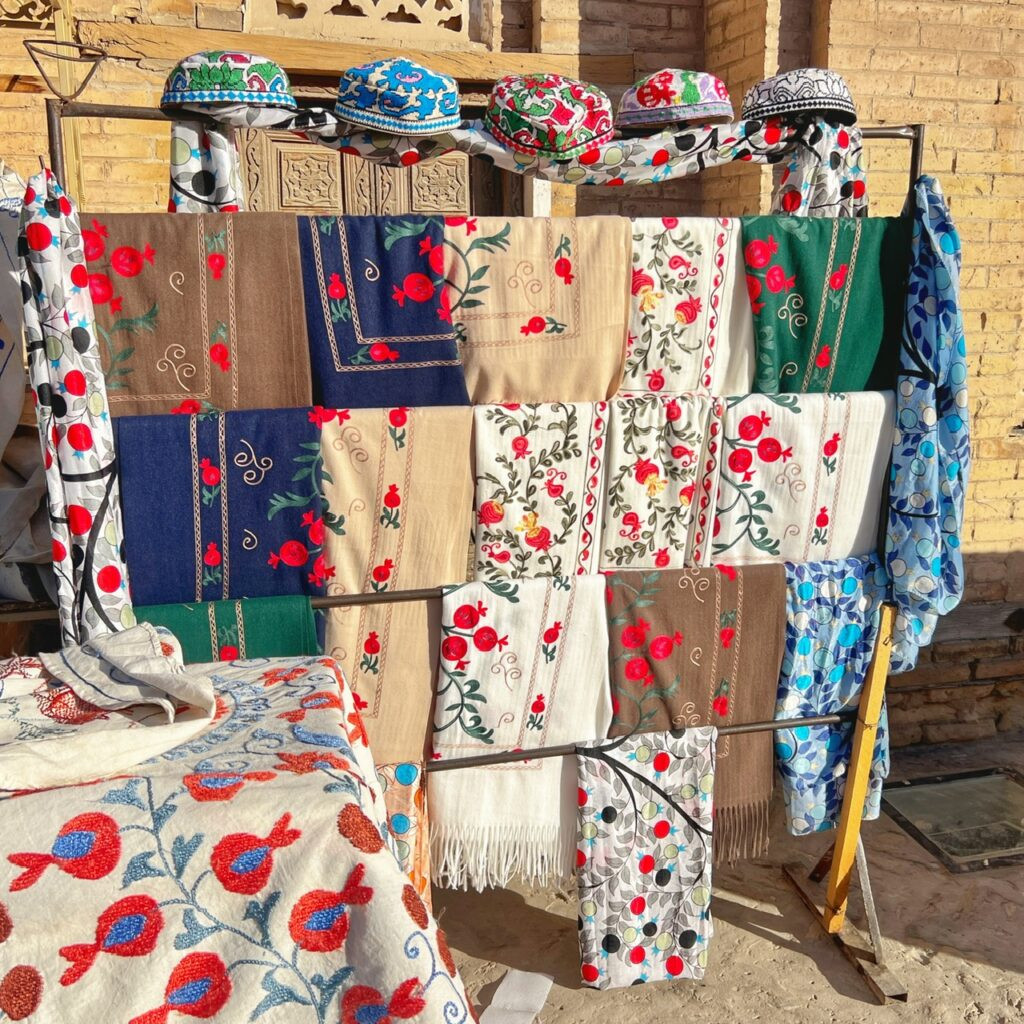
Souvenirs doused with pomegranates. In Uzbekistan, these fruits are ancient symbols of fertility, love and abundance, thanks to their many seeds.
In Uzbek culture, a pomegranate is often used to wish newlyweds many children and a fruitful marriage, similar to confetti or rice in Western cultures. Uh….wouldn’t that cause a significant staining situation?
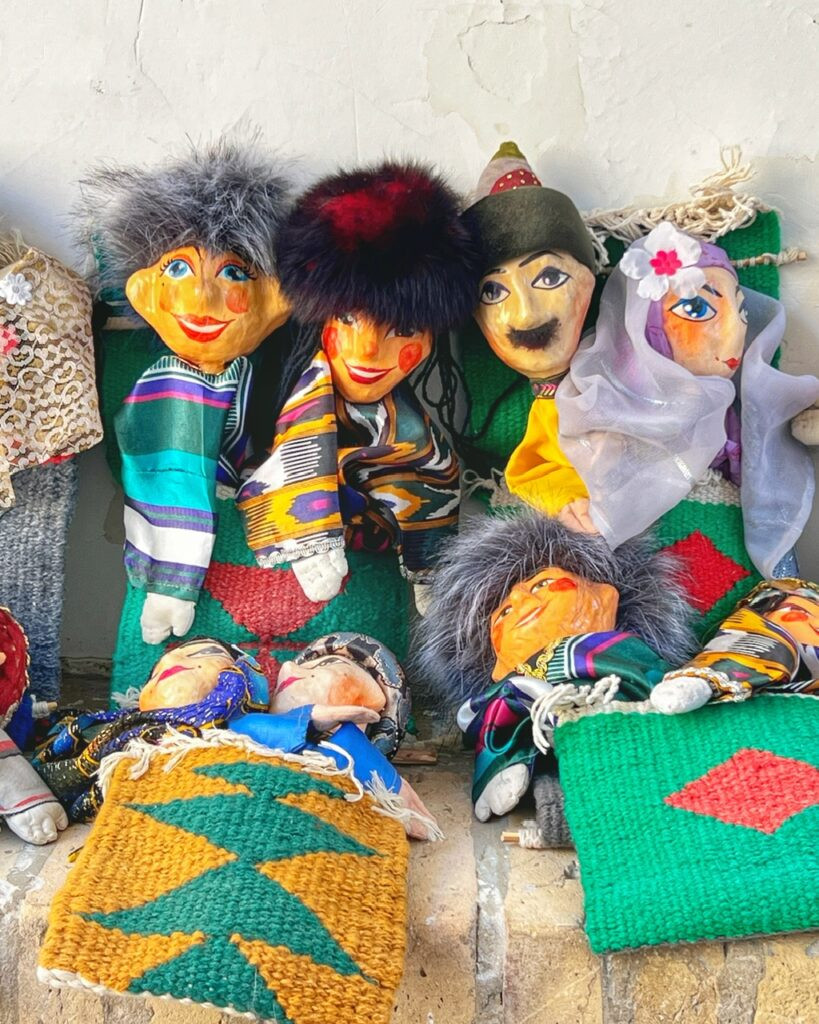
The puppet tradition in Khiva is one of the most distinctive folk arts. It began in the Silk Road era as street and bazaar entertainment blending storytelling, music and craftsmanship.

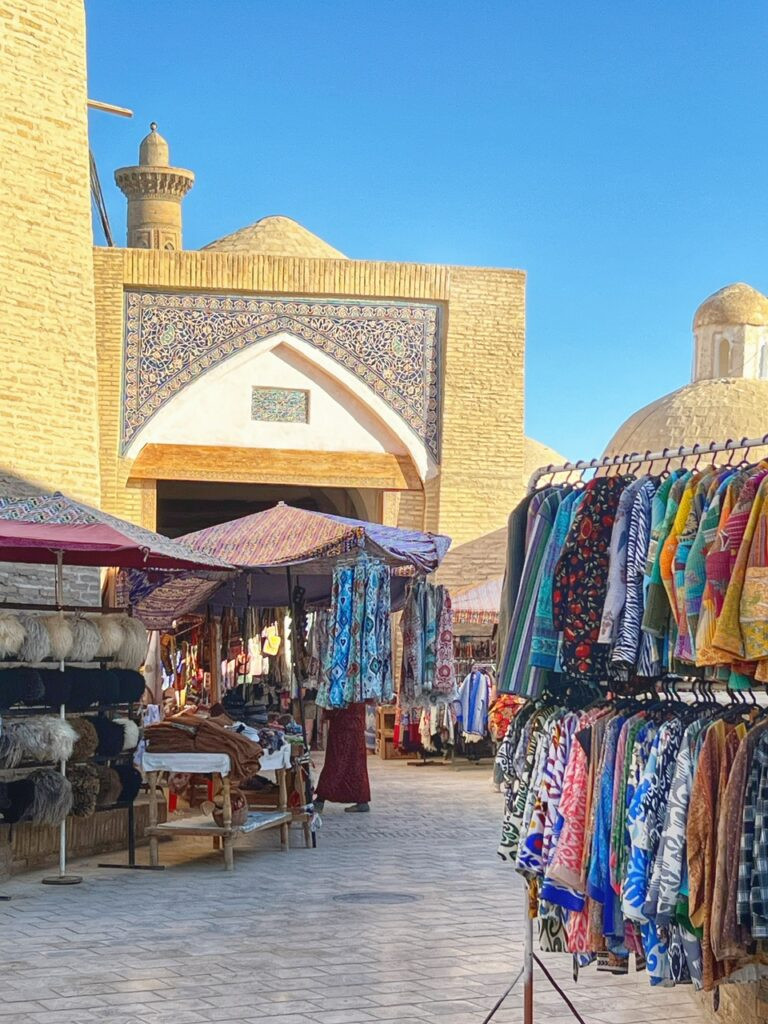
Locals on the streets of inner Khiva. Sadly, most of residents in this part of the town were relocated outside the walls during the Soviet era to make way for shopkeepers, inn owners, or guides. Speaking of shops…there are a LOT of them.
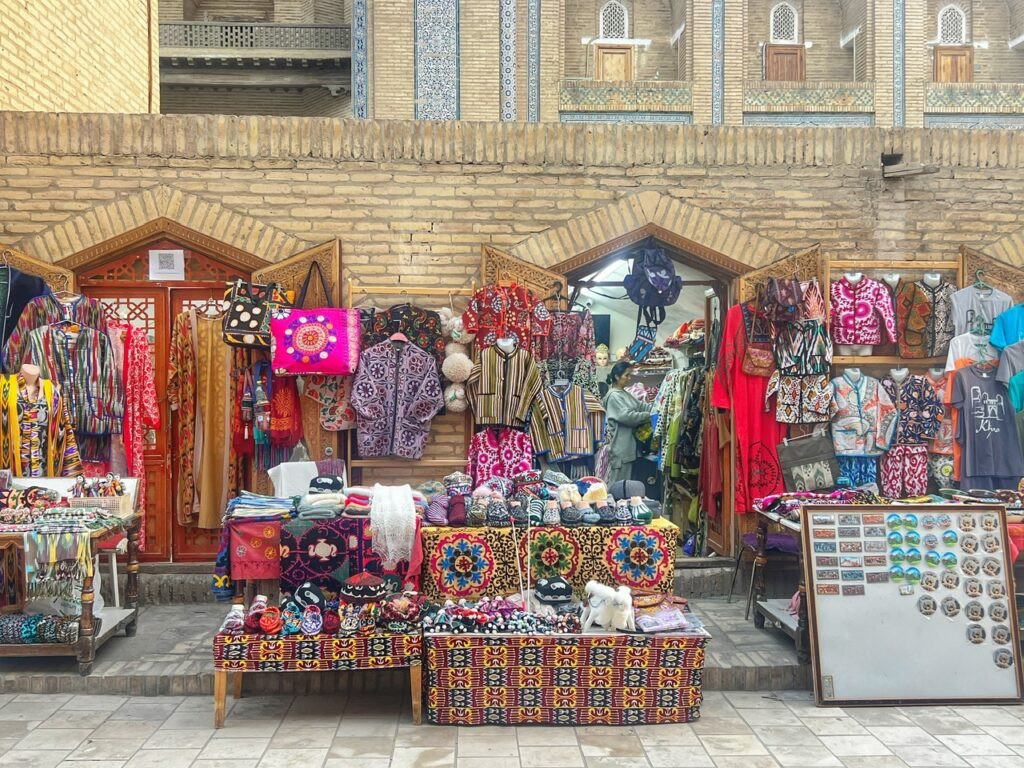
It’s very difficult to walk away without something new here. Mandy got a new outfit, which you’ve seen in previous posts and Greg found a t-shirt. Unfortunately, like most places in the world, women’s fitted t-shirts are impossible to find.

But like always, most of the things we buy are consumables. Our favorite restaurant was called “Khiva Moon,” which we visited twice. Pints of delicious unfiltered craft beer sold for about $2 and the food was also affordable and delicious.
Pictured here is a cabbage salad, carrot salad, and Shivit Oshi, a noodle dish unique to Khiva, which might look more like you’ve been working your Play Doh noodle factory on overtime.
The brilliant green color comes from adding fresh dill into its hand-pulled noodles. It is then topped with a vegetable and/or meat sauce and yogurt. It was definitely one of our favorites in Uzbekistan!

Each of these meals, with beer, cost us about $13. It also included a bonus snuggly lap cat.


Another meal we enjoyed was at Terrassa Cafe, which is inside the wall with a spectacular view. We had veggie kebabs, and “Kapshirma” which was large flaky crusted “dumplings” which was more like a tortilla to us, and stuffed with potatoes, pumpkins and cheese. (Meat also available). It was AMAZING and tasted just like a quesadilla to us, making this the second “Mexican” dish we had in Uzbekistan. (The first was Chicken “Jizz”.) We’ll take it however we can find it!
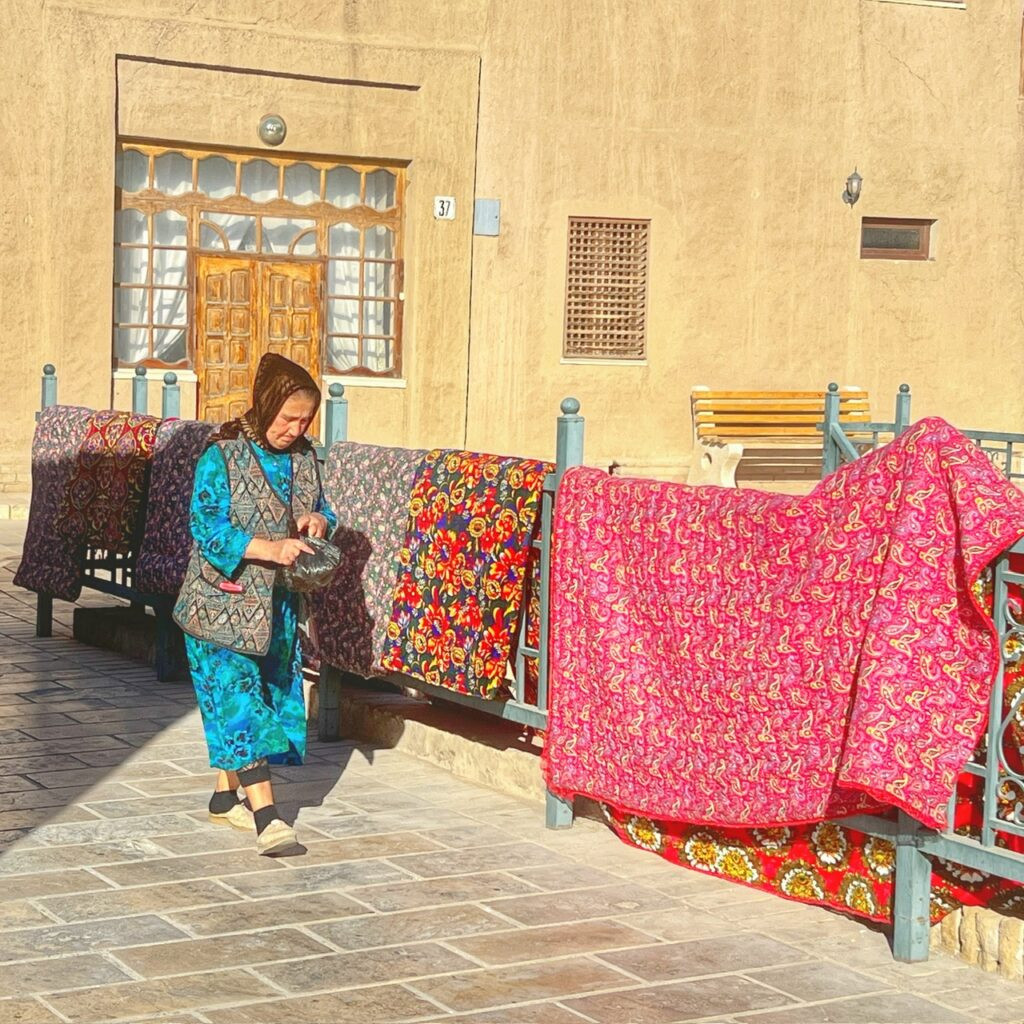
Quilts soaking in the blazing sun. Speaking of sun, we hadn’t had a single cloudy day in weeks. And, with the idyllic temperatures, October was the perfect time to visit Uzbekistan.
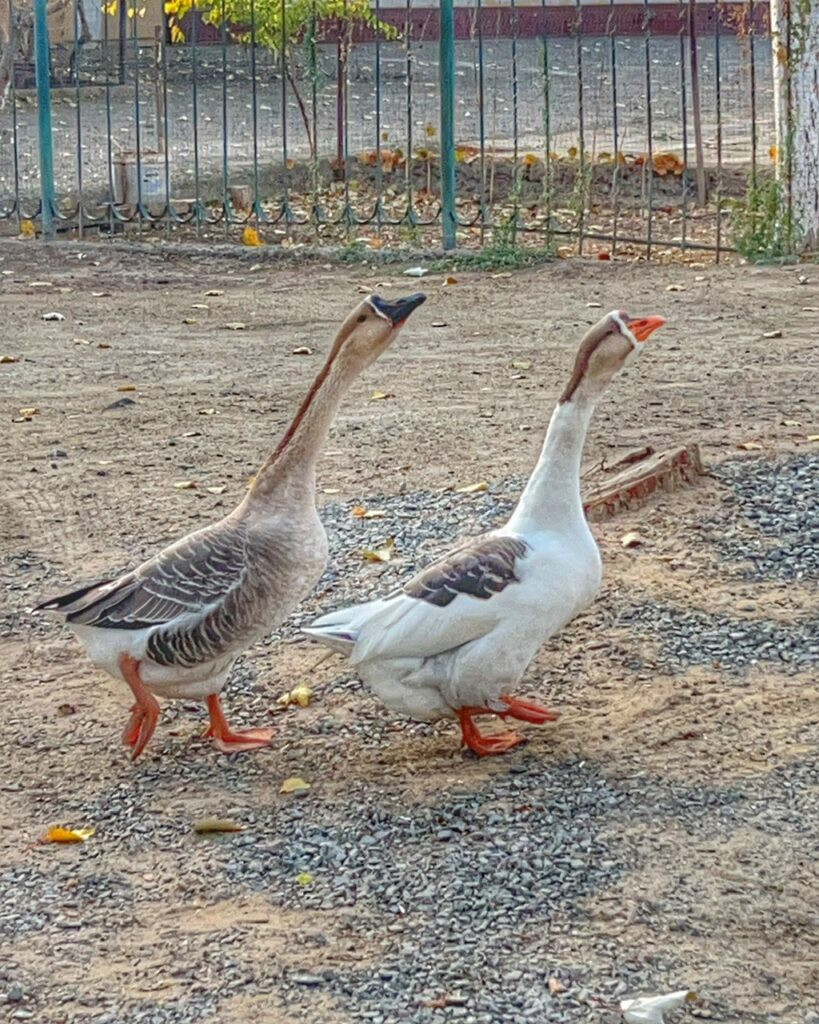
Ambling into other parts of Khiva we met funny-looking geese which were actually “Mute Swan” according to our “Seek” app.
They are native to Eurasia and the name “mute” derives from it being less vocal than other swan species. It’s true…neither one was particularly chatty.
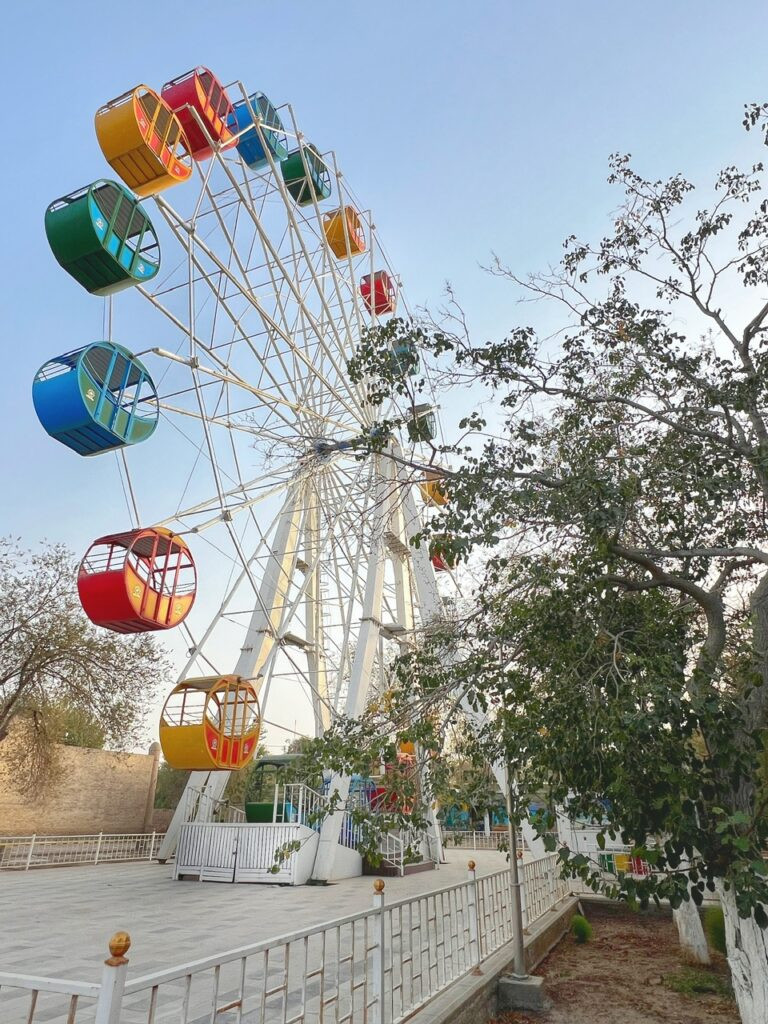
We also wandered into a seemingly abandoned amusement park with quintessential colorful Ferris Wheel pods.

We also encountered other “ride” contraptions, which seemed to be lacking a bit on the safety front, especially since Mandy could climb right inside.

In the same nearby park, we found a statue of Avaz O’tar, a respected Uzbek poet of the late 19th/early 20th Century. He stood gently framing the towering Uzbek flag, (thought it had nothing on that man pole in Dushanbe).
The Uzbek flag itself has a whole lot going on.
- 12 stars reflect the months of the year, symbolizing time, eternity and order.
- Blue stripe represents sky, water and life.
- White stripe; peace and purity.
- Green stands for nature, fertility and Islam.
- Red lines; flow of life and power of vital energy &
- Crescent Moon; traditional Islam but also a rebirth of Uzbekistan separate from Soviet.
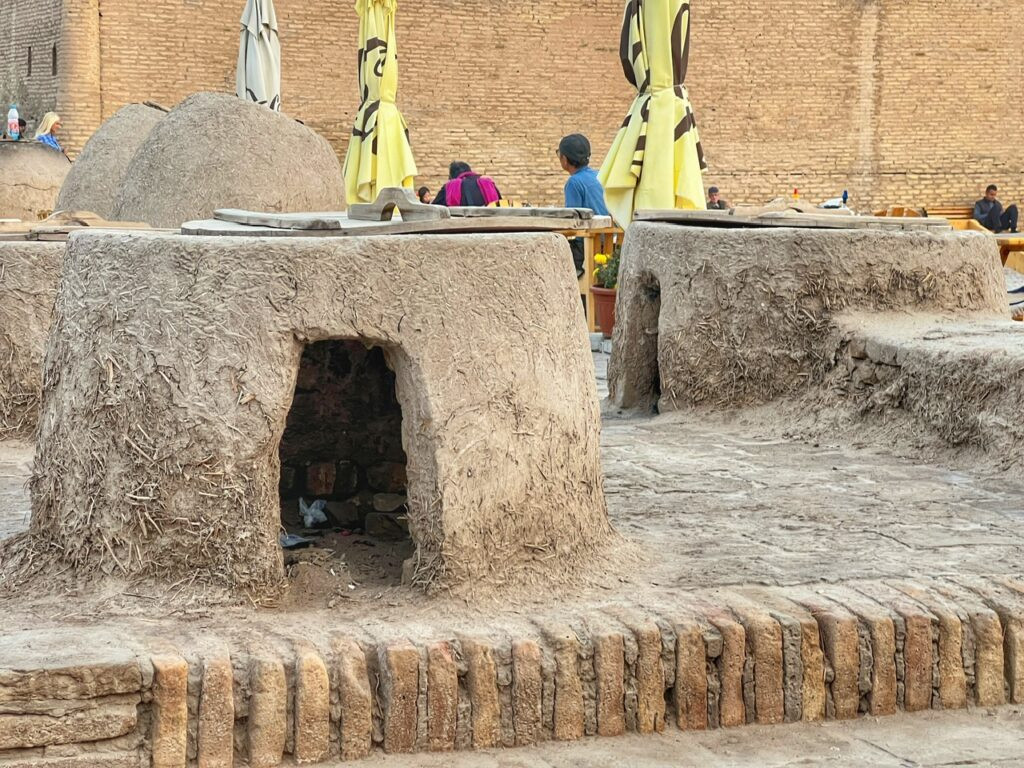
Traditional clay ovens, called tandirs, which are used for baking bread and roasting meat in Central Asia. The interior gets extremely hot: 400-500 Celsius, or 750-900 Fahrenheit! Yikes! Remind me not to stick a hand in there!! Today, fortunately, these ovens in the square are probably just decorative or you know what kind of tourist troubles they’d bring!

Another fun thing we got to experience in Khiva was walking into a movie set. Not surprisingly many period pieces on the Silk Road are shot in the historic center.