
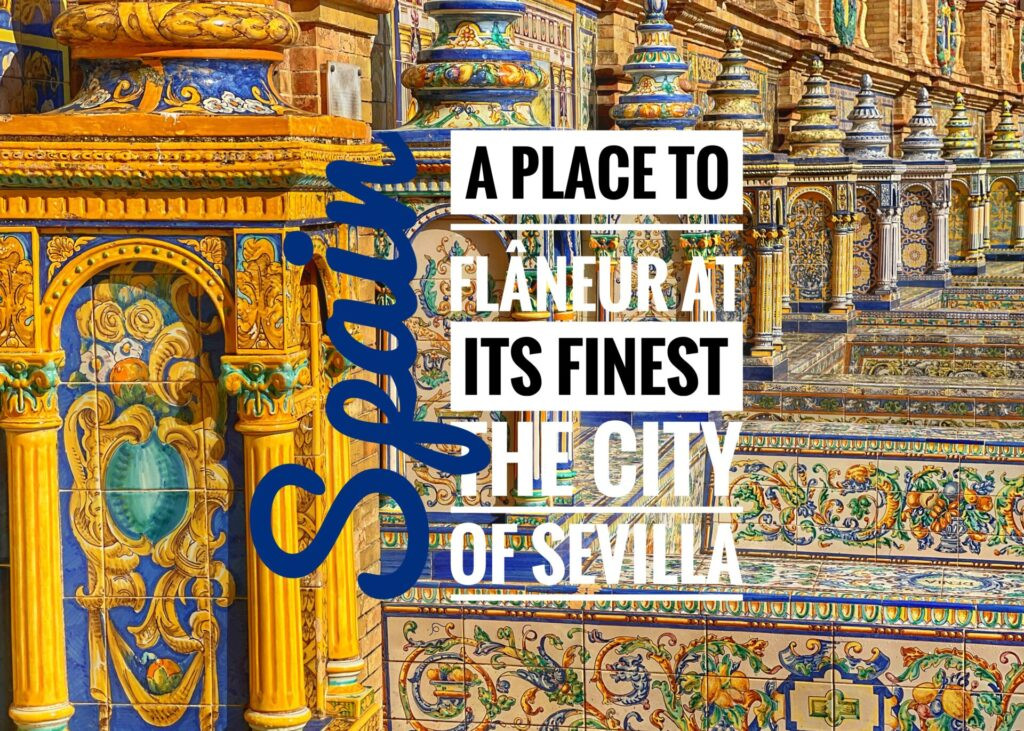
From Porto, we jubilantly traded in our three words of Portuguese for Spanish as we boarded a 6-hour BlaBla car ride south to Sevilla with a pair of sultry-looking Spaniards, Daniel and Carlos. It cost a whopping $109, but whacked the bus time in half for the same price, which made it well worth it. It also meant we would not be sleeping on the bus, which we really need a break from.
This would be our first jaunt to Andalucia’s sparkling capital of Sevilla and although we have different feelings on other parts of Spain we visited in 2022, Sevilla was far from overrated. In fact, this starry-eyed sensation, aka the entry port for New World trade in the 16th & 17th Centuries and birthplace of flamenco dancing, is utterly dreamy.
But it’s far from inexpensive, especially if you shell out the typical 10-15 euro entry fees for all the major sites. Naturally, our day in Sevilla was different than most tourists, as we did it our preferred crowd-avoiding (yes, there’s a ton, even in early December) and budget-friendly way….

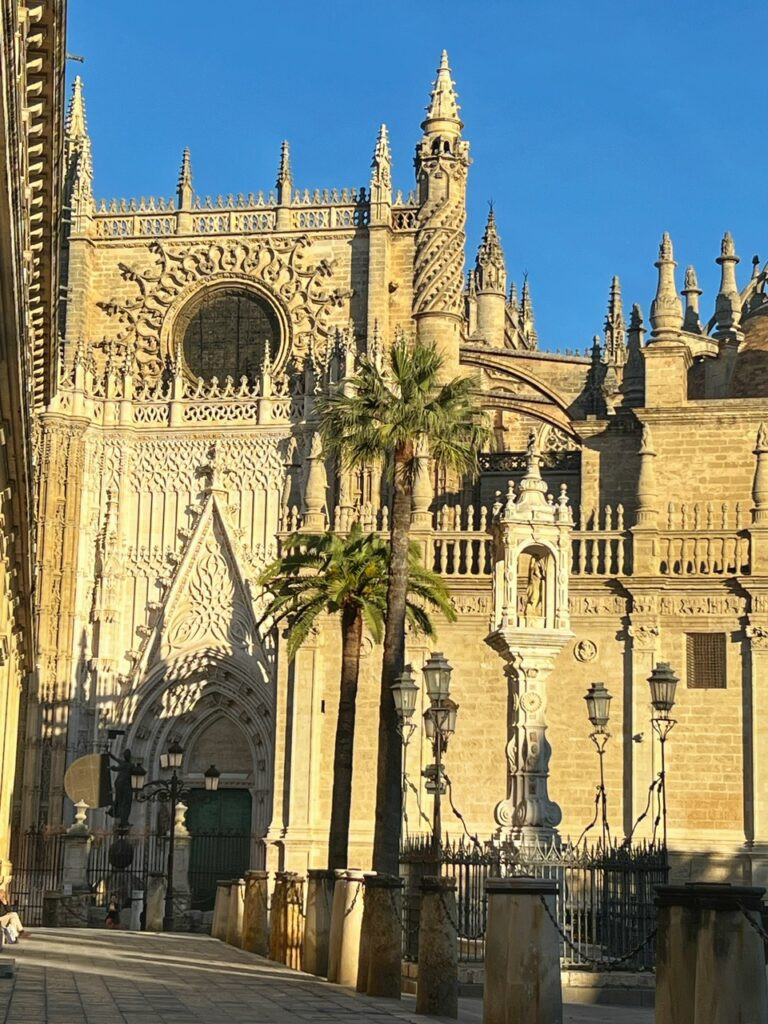
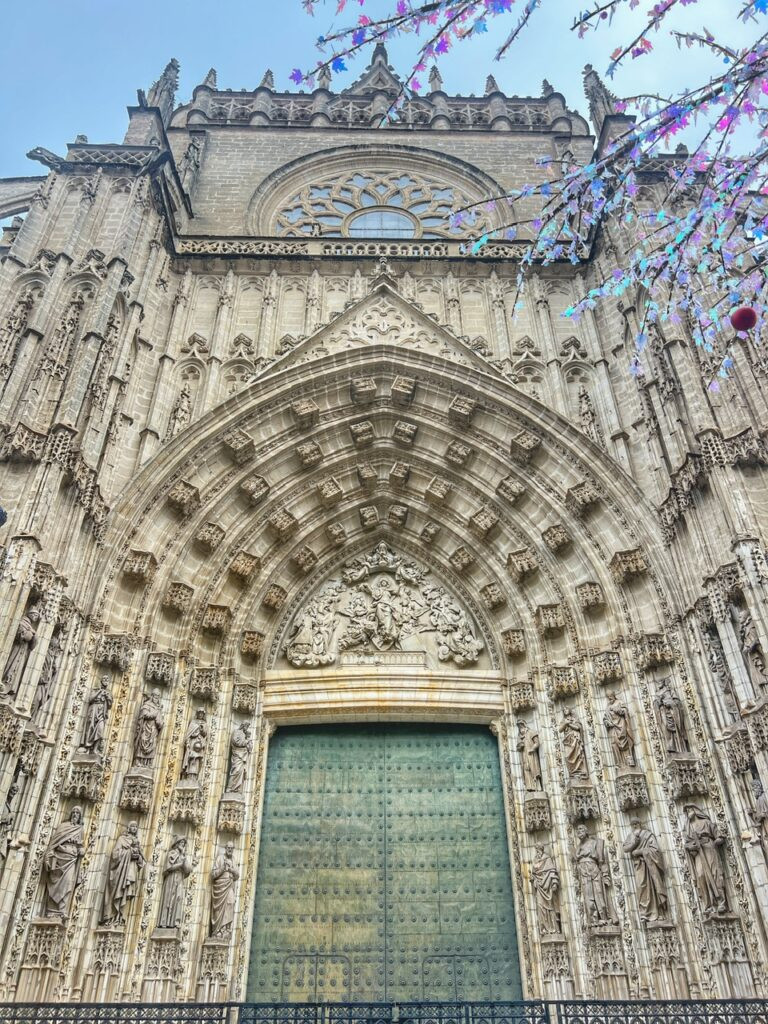
The magnificent Seville Cathedral is the largest gothic cathedral in the world, and one of the biggest churches ever built. In this photo you can see La Giralda, which was once a minaret of the previous mosque when Sevilla was reconquered from Islamic rule in 1248. Unlike most bell towers, it is accessed via ramps, which was designed so lazy riders on horseback could get to the top. For those willing to spend their vacations in long lines and chuck out the $16 to enter beyond the lavish exterior, you will be rewarded with a brush of mega history at Christopher Columbus’s tomb, whose coffin was hoisted by four Spanish kings, and may or may not actually include all his remains.

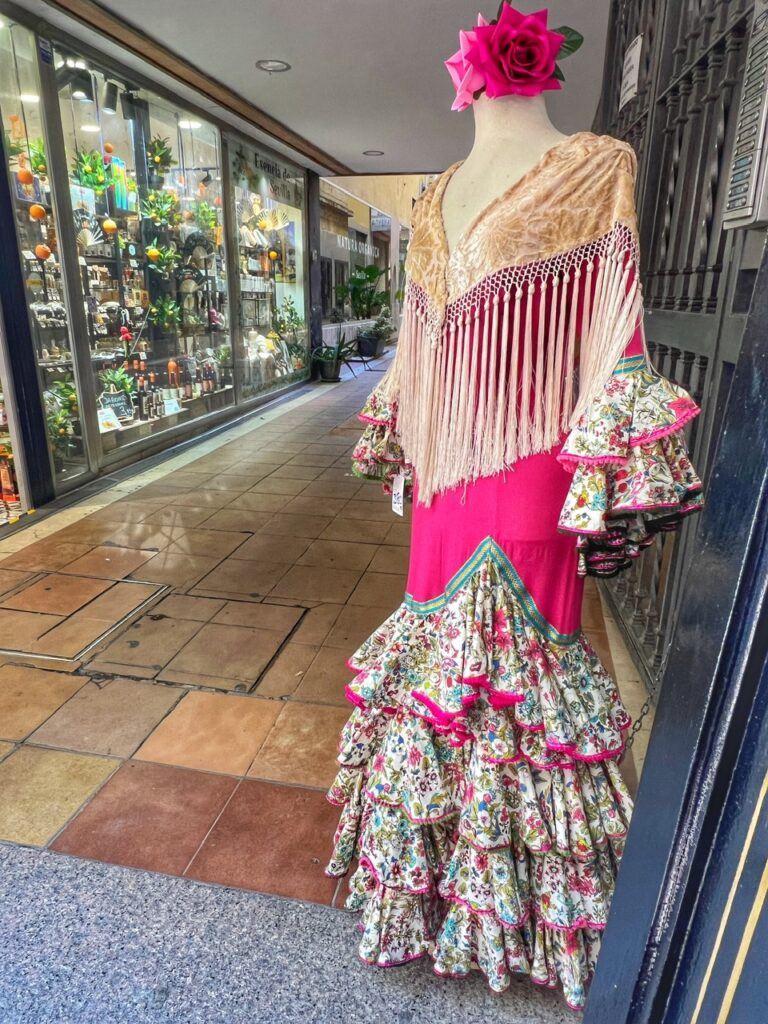
We’d rather experience daily life in Sevilla at a flower shop, and admire flamboyant Flamenco dresses.

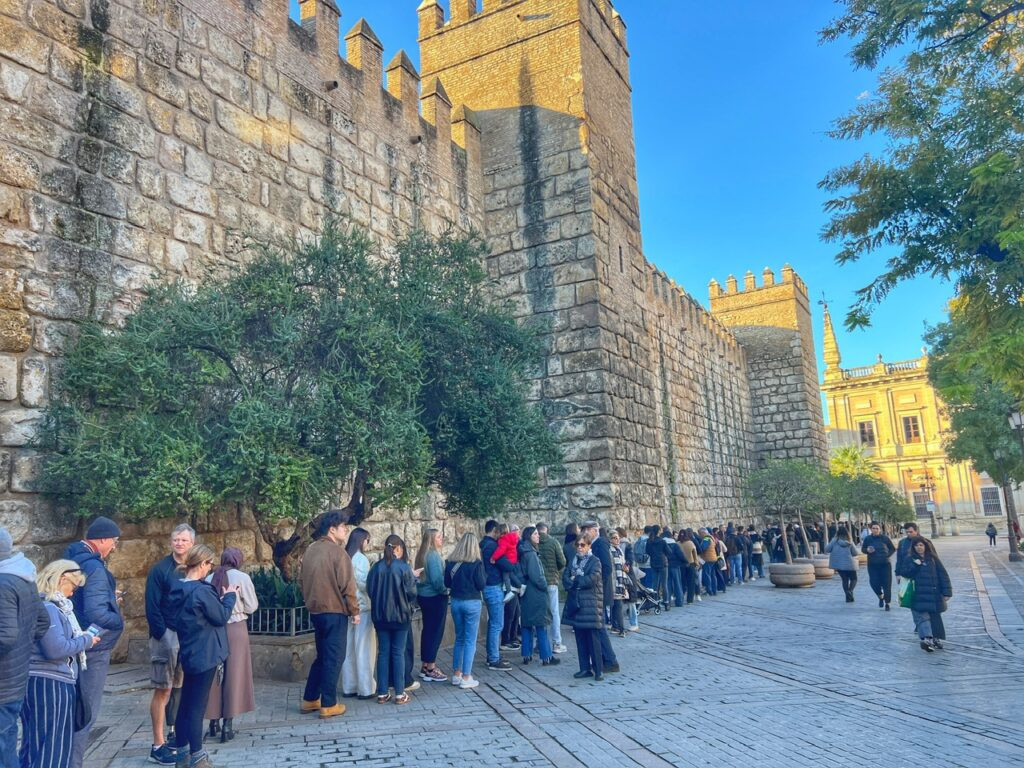
Backing up a bit, we emerged from the classy Hotel Murillo about 9:00, thirty minutes after the ridiculously tardy Spanish sunrise. We’d gotten our room for $78 room we got for $28 thanks to a $50 Booking/com credit from Rakuten. (Ask us for a referral if you’re interested.) We then strolled by the insanely long line to enter the Royal Alcazar palace, which has free entry on Mondays, but you need to grab your tickets online in advance.


Instead, we wandered over to the completely empty Torre del Oro, which is also “free” on Mondays. “Free” because there is still some light pressure to donate something at the door, which is only payable by credit card, but a euro each seemed to be sufficient. The Torre del Oro is a 13th Century defensive tower built by the same Islamic guys that built the base of La Giralda. When Sevilla was threatened, soldiers stretched a massive chain from the Torre del Oro to another tower on the opposite bank to block ships from entering. A chain eh? That doesn’t even work for a bike lock these days. 🤣
Inside the tower is a naval museum, which naturally pays homage to the grand daddy of the Americas…at least as we had it drilled into our heads as innocent children. We also witnessed models of the Nina, Pinta, and Santa Maria, as well as other indoctrinations we’re intimately familiar with like Columbus and gang making buddies with the Native Americans.
Being atlas aficionados, we were a bit more impressed to see the oldest cartographic work preserved featuring the American continent on two pieces of leather parchment by Juan de la Cosa.

Moving on, we checked out the outside of Plaza de Toros de la Maestranza, which is the oldest bull ring still in use dating from the 1700s. Yes, you can still see bullfighting for those who enjoy blood and violence!


By this point, it was 10:15, and time to pick up breakfast for our grumbling tummies…buffet cast-offs from hoity toity types at a fancy four star hotel, which we got for 4 euros through Too Good to Go…instead of our own hotel’s 13 euro option. Enjoying our buffet box while sitting in a sunny riverside park. After this, we traversed into the Triana neighborhood, but we’ll save that for another post.


Coming back across the river, we got sucked into a shop where every single shopper was stroking something as if a sign outside had boldly told them to “Touch…EVERYTHING!” Yes, it was loaded with nothing but cozy jammies all on discount for “Black Week” because the Spainards realize that advertising the one day is simply fake news. Needless to say, I indulged in a $9 powder blue snowflake ensemble which will help me survive the winter months until I can unthaw in January. SI, HACE FRIIIIIIIOO(!) in Southern Spain.
I’ve actually yearned to come to Sevilla since 7th grade when I was forced against my will to do a term paper on opera, which for a 12-year-old felt agonizingly boring at first. Somewhere in that month of research however, I had to admit, the stories grew kinda interesting. While I did not see Carmen, Don Giovanni, or the Barber of Sevilla on this visit, I did see the Barbero.


Breakfast of Champions…at around 10-11 am, for the Spaniards. Less appealing was the dotting of cured jamón legs protruding from the windows of multiple tiny shops, complete with a “come hither” hoof gesture.


Moseying along, we arrived to the main pedestrian drag of Sevilla called Sierpes Street, which in early December is draped with glimmering garland which glints boldly in the sunshine. It includes lots of tucked away spots for al fresco treats, and other sites easy to overlook like the Capilla de San Jose, folded into the narrow streets off of Sierpes’ bustling bosom.

This baroque treasure was built between the 1600-1700s and has a small footprint, but big impact. The facade of the chapel is ornamental and warm-colored with inviting sculptural detail.


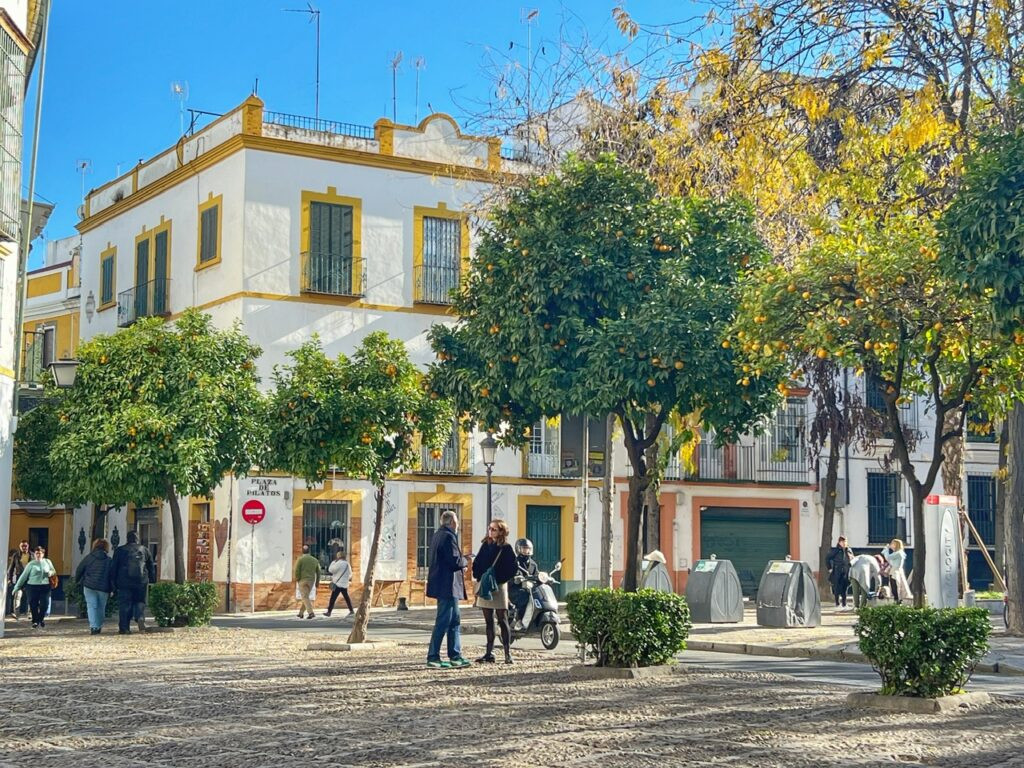
Other warm art sprinkles the outside of a nearby florería. Also, while in Sevilla, it’s also a must to putter into an orangeria, which has loads of free smells and dabs of the city’s most powerfully pungent product. Unfortunately, we personally discovered, the oranges that dot the 40,000 street trees of Sevilla are a bit bitter…and puckering. Apparently, their fruit mainly goes to the UK to make more things weird things that Brits love…orange marmalade.

Serving as the gateway to Sierpes Street, the historic pastry and coffee shop, La Campana, dates from 1885.
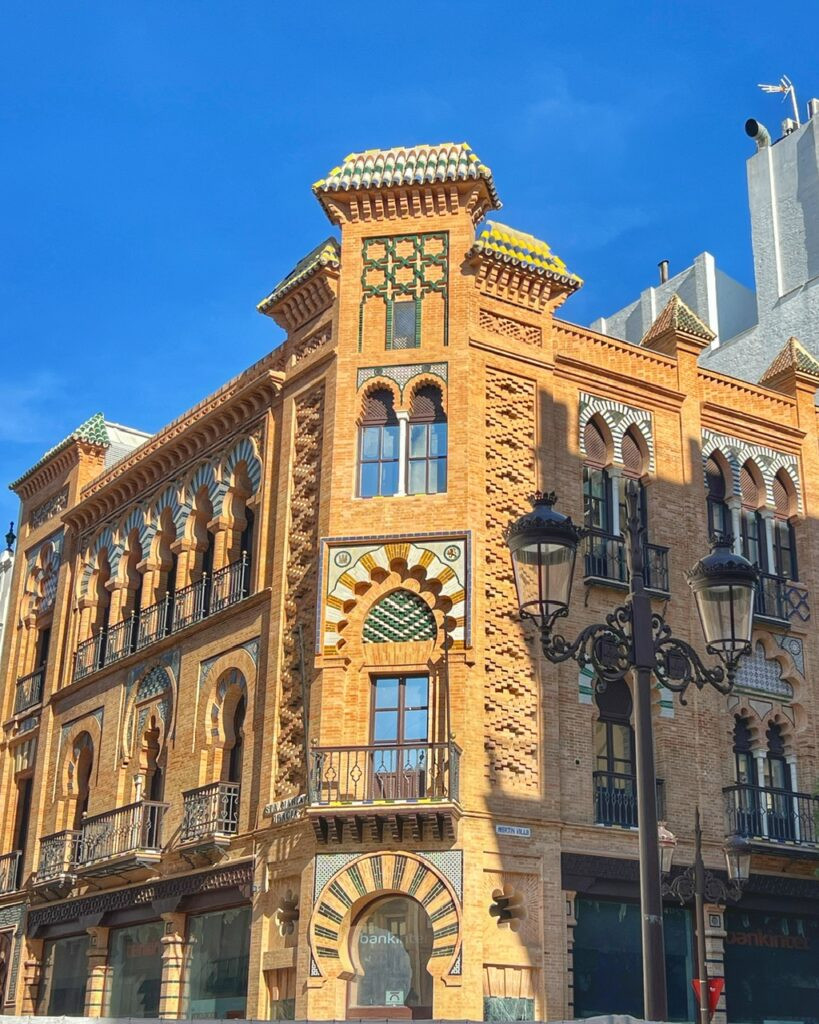
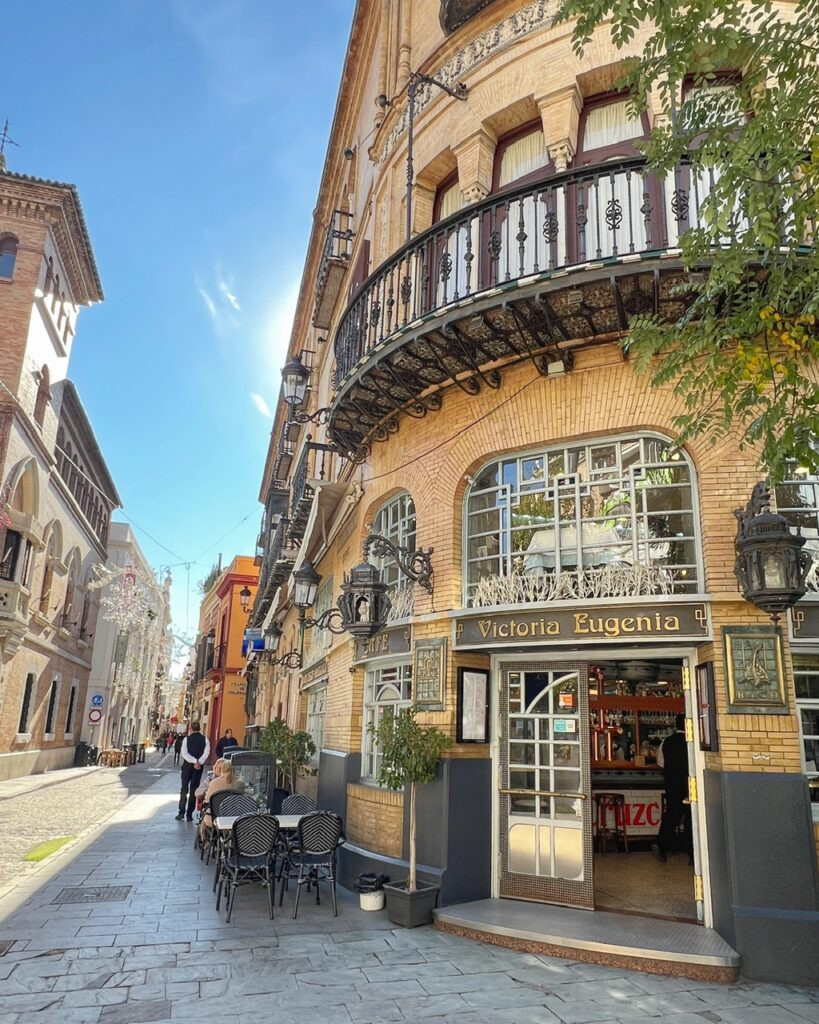
Of course it’s really not easy to choose where to indulge…everywhere is appealing. This included our first brushes with the famous Spanish/Moorish architecture blend. So beautiful!

Peaking in the mosaic-ed entrance of the Palacio del Marques de la Motilla

Although most of the city is blanketed in old world charm, if you’re ambling through Sevilla you’ll inevitably encounter the modern blanket of “Setas (or wild mushrooms) of Sevilla,” a wooden web of world wonder, which is apparently the biggest of its type at 150 by 70 meters and 26 meters high.
Naturally, when it was first being constructed in the late 2010s, there was a near-uprising from locals in Sevilla using jamón legs as muskets who didn’t feel that wild mushrooms meshed well with its historical ambience. Today, it’s mostly embraced as a unique part of the city. Also, nearby at the Casa de Pilatos

Around 3:00 p.m, we retired to our room for a siesta so we could stay out til 10:00 and eat tapas (aka dinner) at the acceptable eating hour of 6:00 p.m. We went to “Los Coloniales” which a friend recommended as an old quarter “budget” option.
As in the past, we were not overly impressed by the fried and heavy food laid out before us and still don’t understand the obsession with this scene. The wine, however, we excitedly jumped on board with. In the end, we spent $27 on five small plates and two glasses of wine.


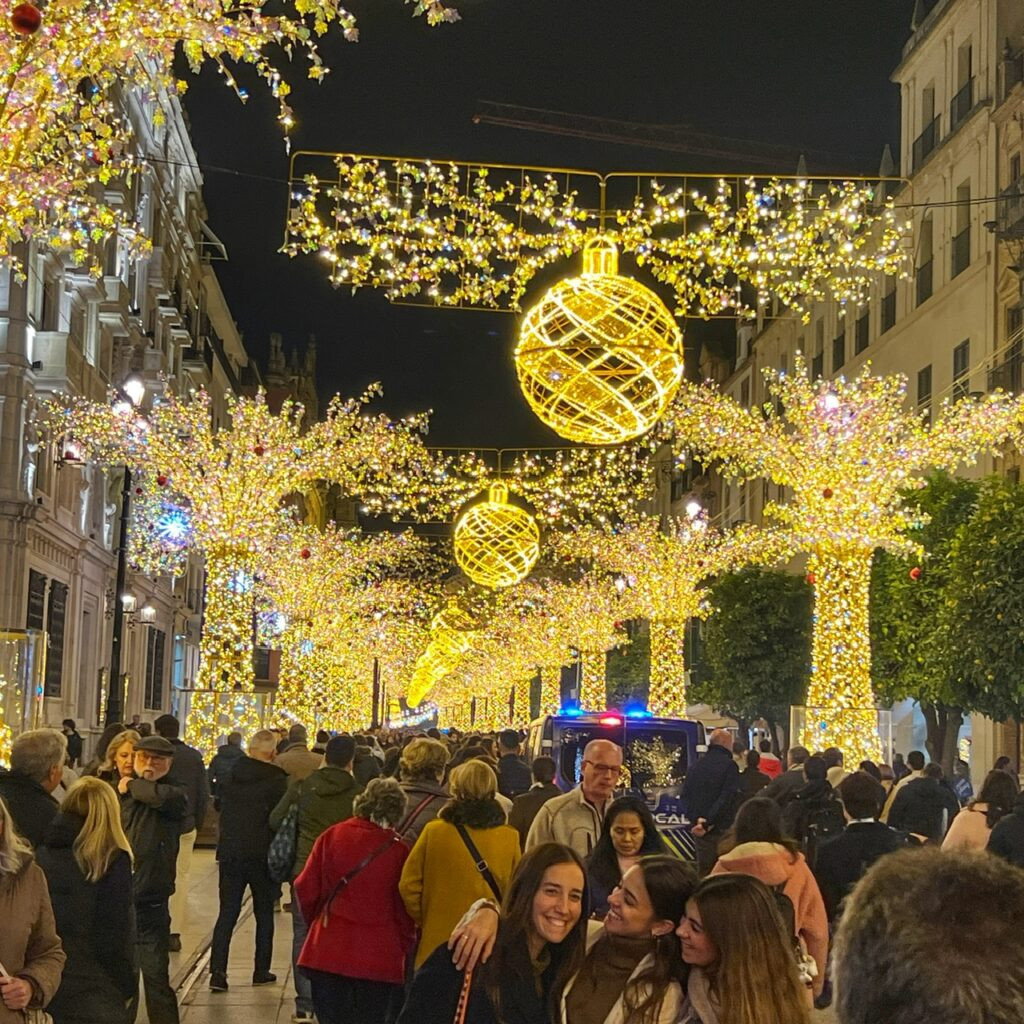

After our tapas, we wandered some more through the empty light strewn back alleys, and the saturated main thoroughfares. The lights were gorgeous and it was also really pleasant to enjoy them without freezing like we have in other European destinations in years past. (I’m looking at you, Brussels and Nuremberg!) But the crowds were equally enormous. The best part was checking out the dazzling light show on the side of City Hall. Do not want to even imagine what this city is like in other seasons!
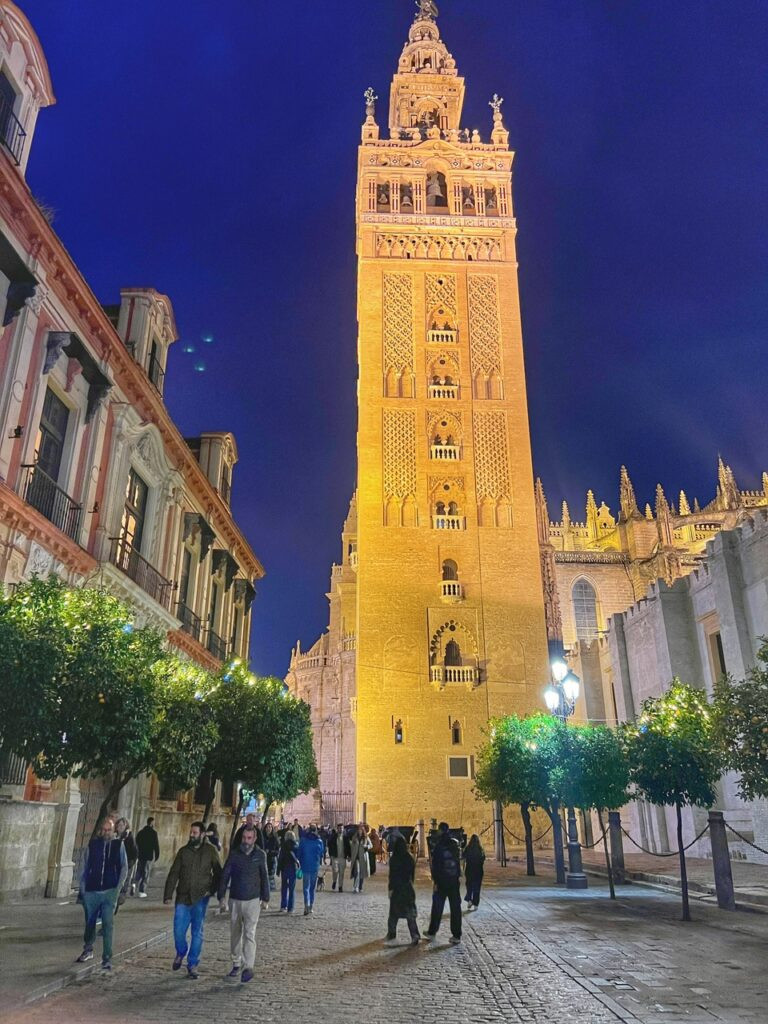

The Seville Cathedral by night, followed by our nightcap…at 8:30 we arrived to the cozy, local-feeling joint of “La Carboneria” where they have a FREE nightly flamenco show. We were happy to pay 3 euros (cash only!) for a glass of wine, and a chance to glimpse at this emotional and rhythmic art form, still making it to bed about when the Spaniards were serving up dinner, and wrapping up our day’s budget at $73.08.
The Art of Flâneuring


Whether roaming the Crayola-encrusted pueblos of Colombia, surveying the buzzing but jolly daily laborers of Mexico, or strolling through the elegant boulevards of Buenos Aires, at its core, Hispanic culture offers something that has always deeply attracted us…societies that appreciate community, while melding vibrancy, life, purpose, and the value of slowing down.

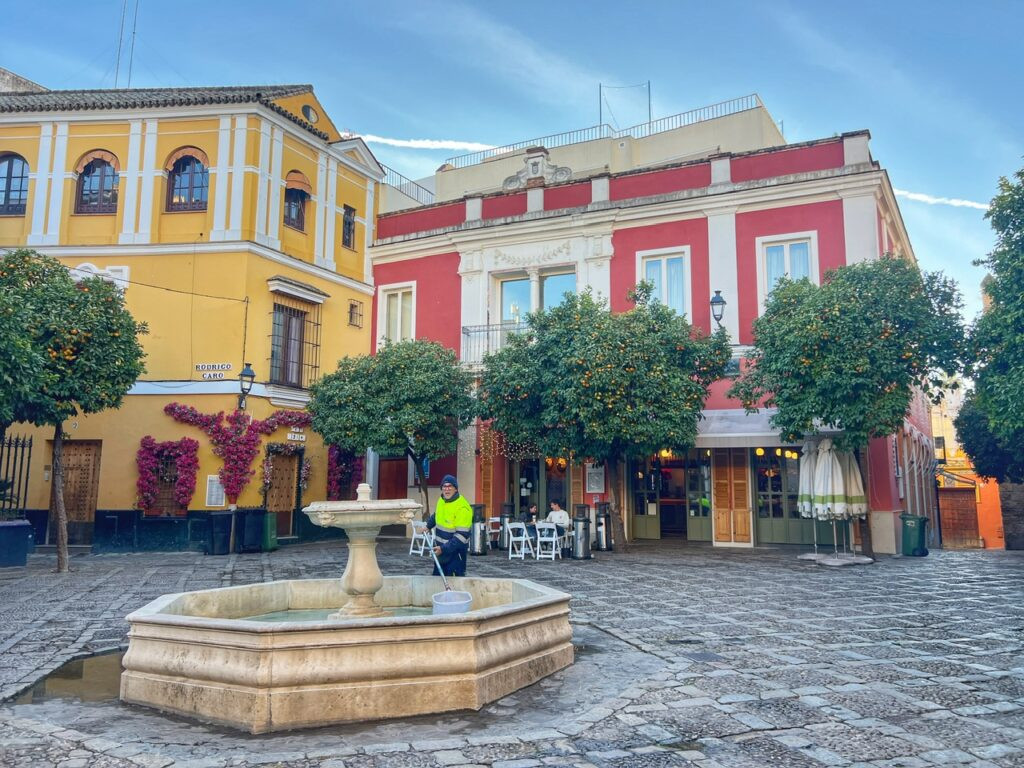

And we’re now realizing all the more, Spain unsurprisingly holds a piece of that treasure as well. Sevilla, particularly, is unequivocally a place to flânuer…to weave a tangled web through its labyrinth of alleys frozen in the pages of time while admiring its pockets of undeniable prettiness…


According to a Chat GPT search, “the word comes from French—roughly “to saunter”—but the cultural meaning is richer. It’s the figure who moves slowly through the crowd while never quite belonging to it, someone who treats the city like a living museum and themselves as both spectator and specimen.
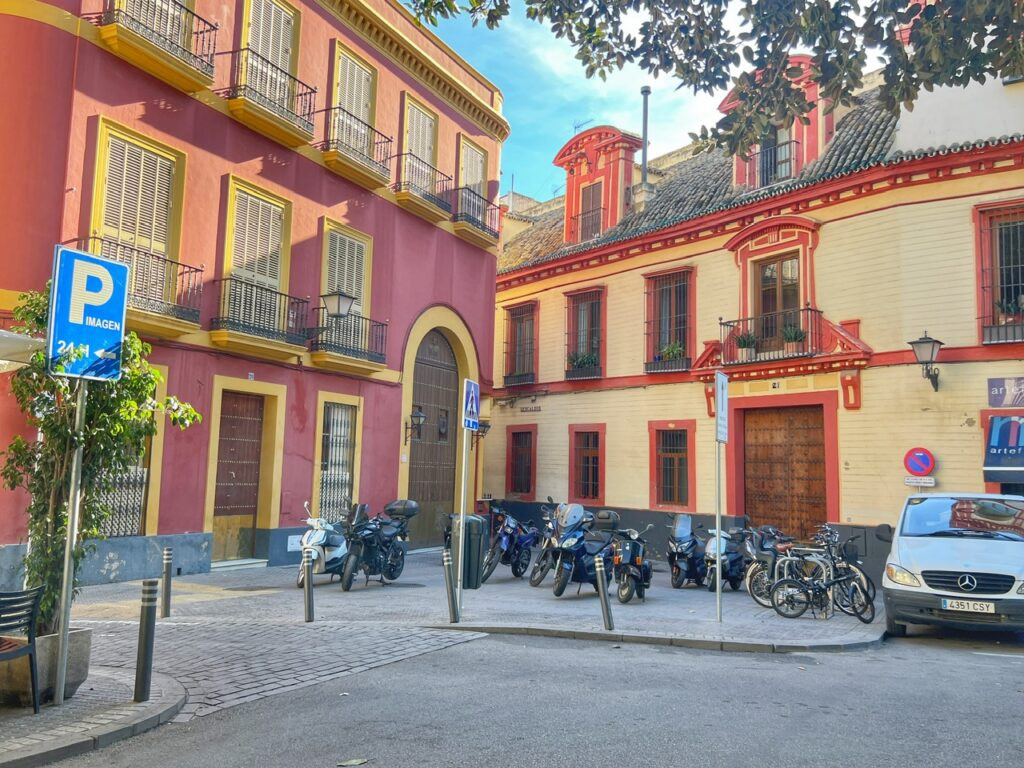

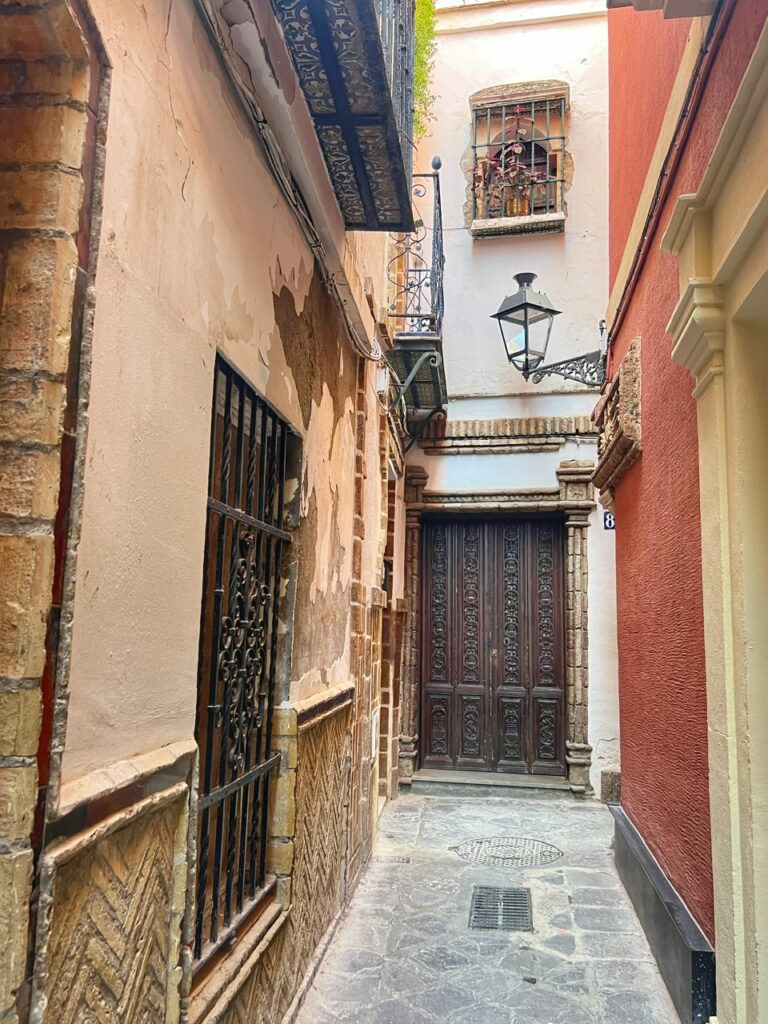
Writers like Baudelaire and later Walter Benjamin turned the flâneur into a sort of philosophical creature: part detective, part daydreamer, part social antenna. It isn’t about laziness; it’s about deliberate, attentive drifting. The world gets weirdly generous when you don’t force it to go anywhere specific.”
The Barrio of Triana
Another part of Sevilla that immediately entranced us was the “blue collar” lesser touristed neighborhood of Triana, which is across the Guadalquivir River from central Sevilla, and for us, had a distinct flavor that reminded us of Buenos Aires. Triana historically stood apart from the main city and has a robust local identity which was molded by sailors, artisans, and a prevalent Roma community, partly responsible for it also being the birthplace of flamenco dancing.

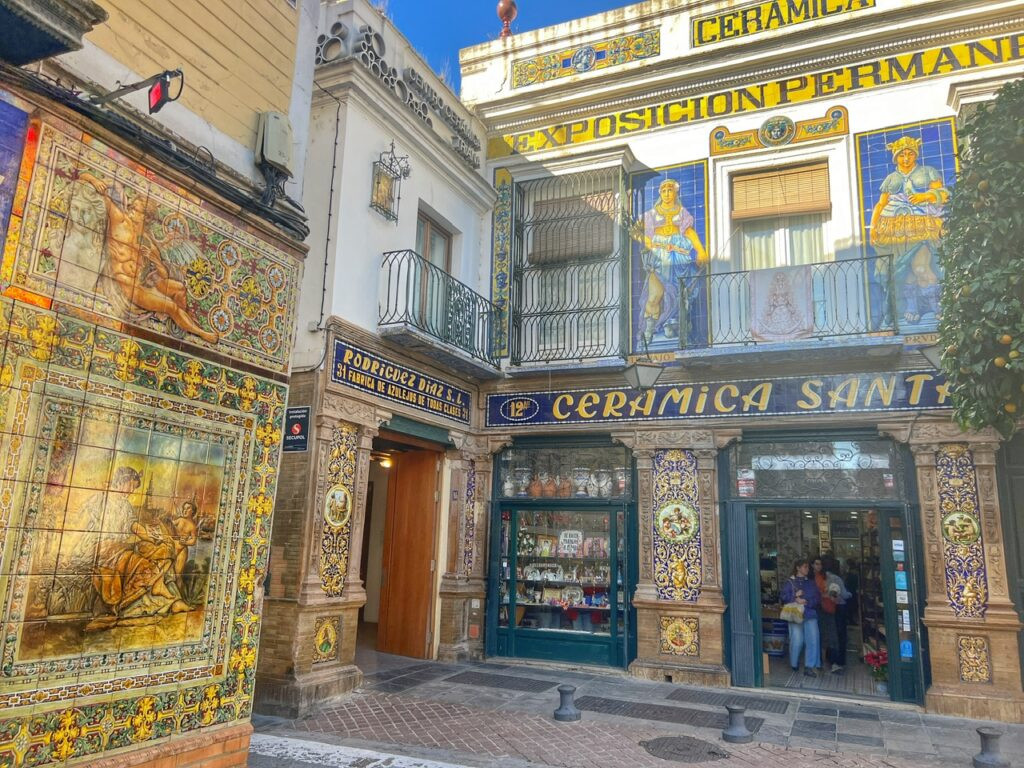
The lively and narrow calles of Triana are also known for its cafes and tapas culture, as well as its ceramic tiles (azulejos) and pottery. Much of Sevillas’ tilework and charm originates in Triana’s traditions.


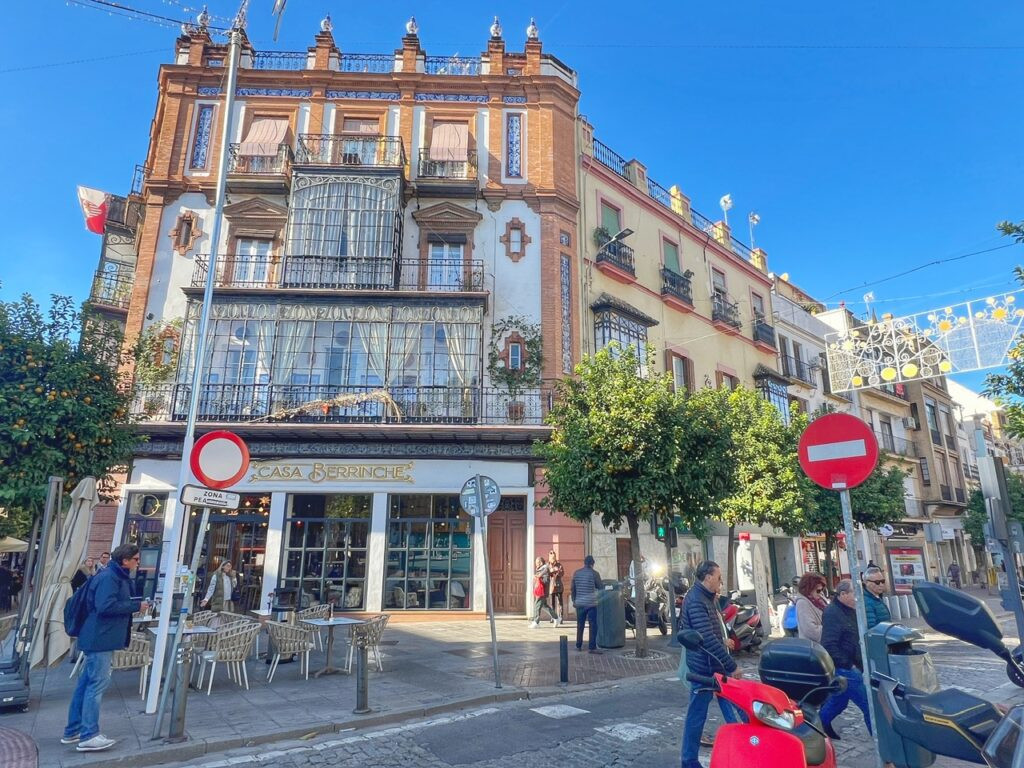
And of course, much of it is ornamented with Sevilla’s emblem citrus spheres.


The crimson-dusted Iglesia de San Jacinto was built in the baroque-style of the 18th Century and represents everyday Triana and its working-class roots. While it’s not a show-stopper, it felt more real than other Sevilla churches, as it blends indistinctly into the scene.

A dental clinic named “Virgin of the Star.” Personally, I don’t want any virgin dentists in my mouth. And we also need at least 4 stars on Google….

An active player in the nightlife scene. Since our free flamenco show was on the other side of the river and we deliberately enjoy retiring our eyelids by 10:30, this would have to wait for another lifetime.
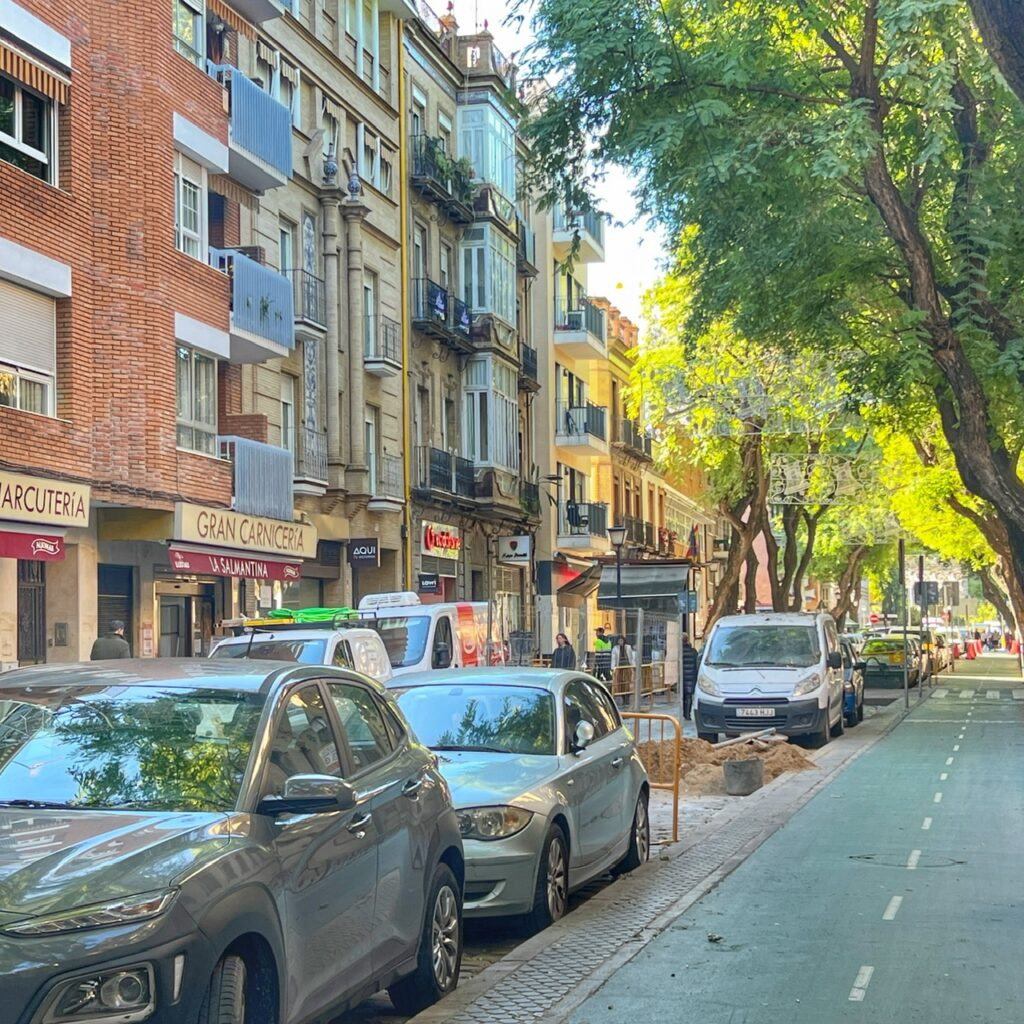

All these scenes needs is a dog walker balancing 15 canines, and you have Buenos Aires. The colors definitely pop a little more in Sevilla, however.


Before we headed back across the river, we stopped for a rare cafe injection at Selva Coffee where sizes ranged from thimble to Starbucks tall. Two lattes with love were a little over $7.
The Plaza de España
For our final morning in Seville, we headed south from the historic center to set lens in possibly the showboatiest free icon of the city…the Plaza de Espana, aka an Instagrammer’s fantasyland. In fact, I must admit I was hesitantly swooned by photos of this site a couple of years ago, which is what reinvigorated our interest in heading to Sevilla before our month long stop in southern Spain.
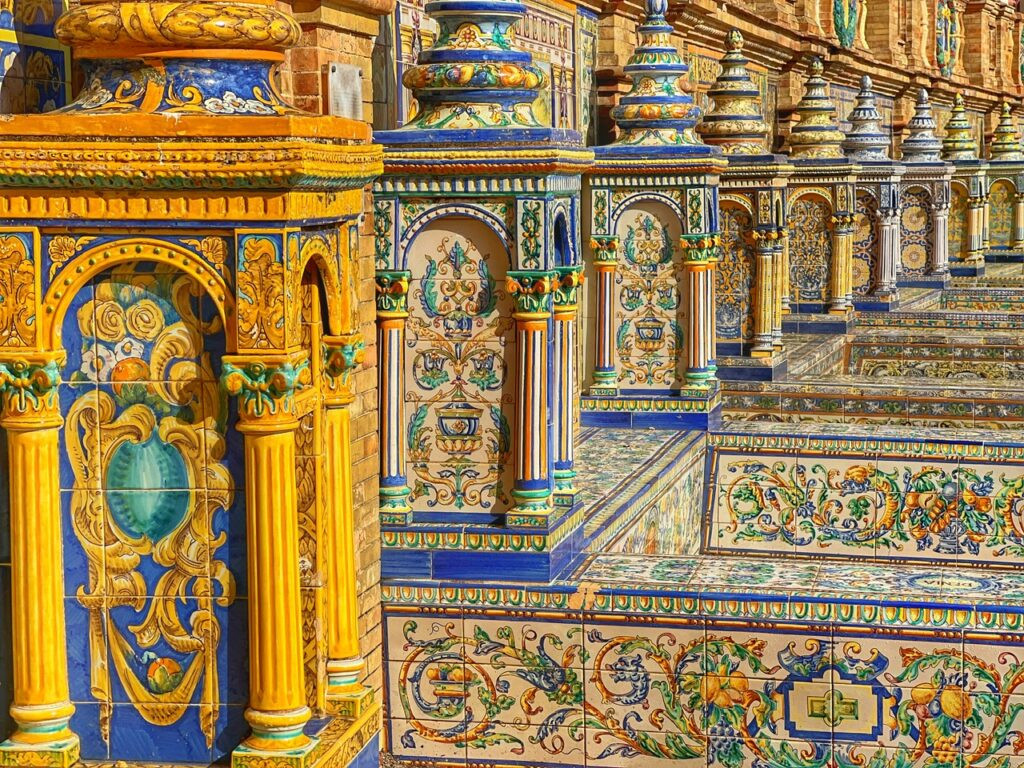
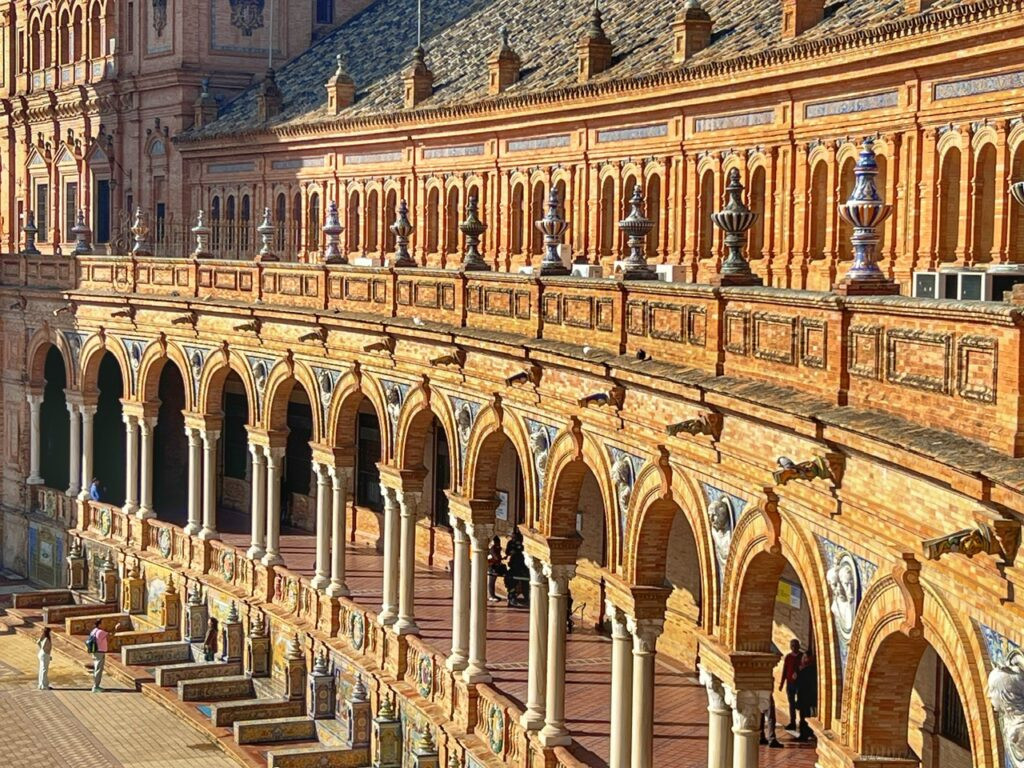
The Plaza de Espana, in Maria Luisa Park, is a seat of grandeur where Spanish and Moorish architecture peacocks itself hard, and the palette explodes on her ornamental tiles, as the light seductively caresses her angles and curves in all the right places.
The plaza was built for the Ibero-American Exposition of 1929, a world’s fair meant to showcase Spain’s ties to Latin America. Chat GPT says, “Think of it as Spain saying, ‘We’ve still got style, history, and a complicated global family tree.’”
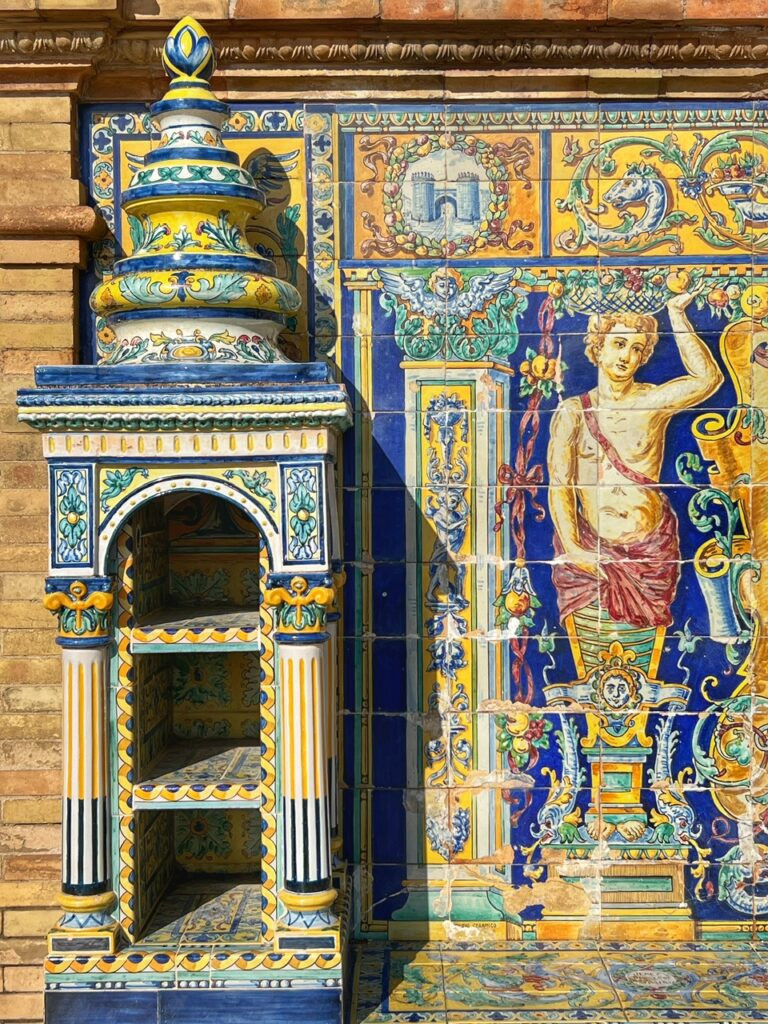
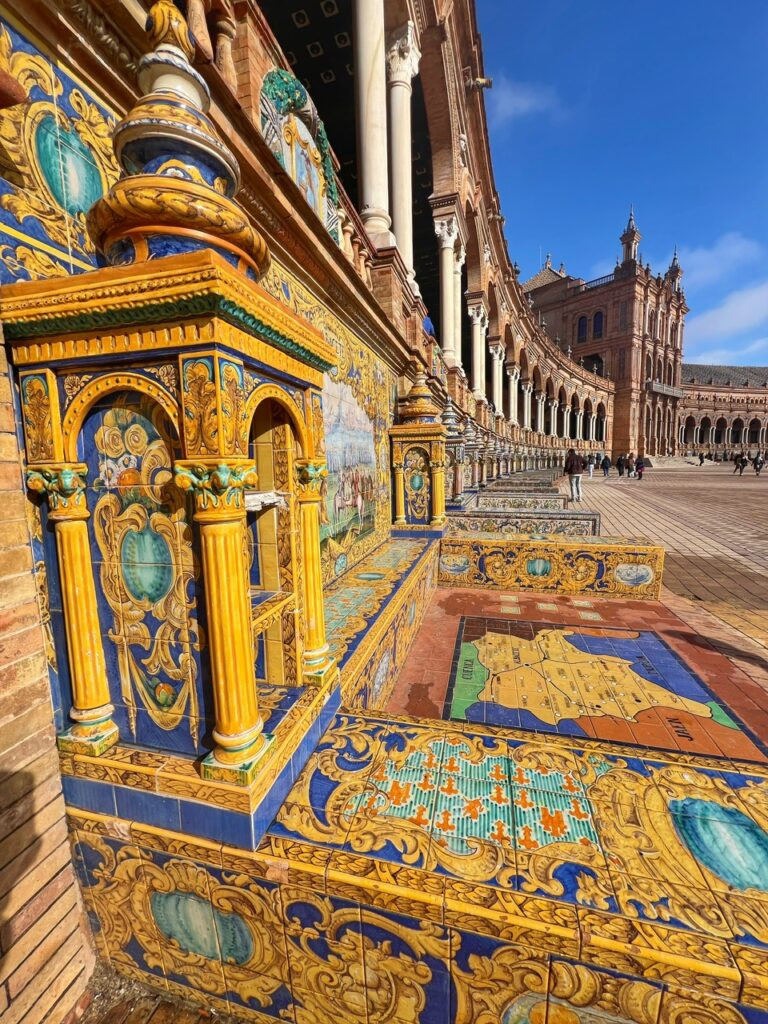
My camera, as the photo I had become entranced by years ago, gravitated immediately to the 48 tile alcoves hugging the perimeter, which each represent a province of Spain as it existed in the 1920s.
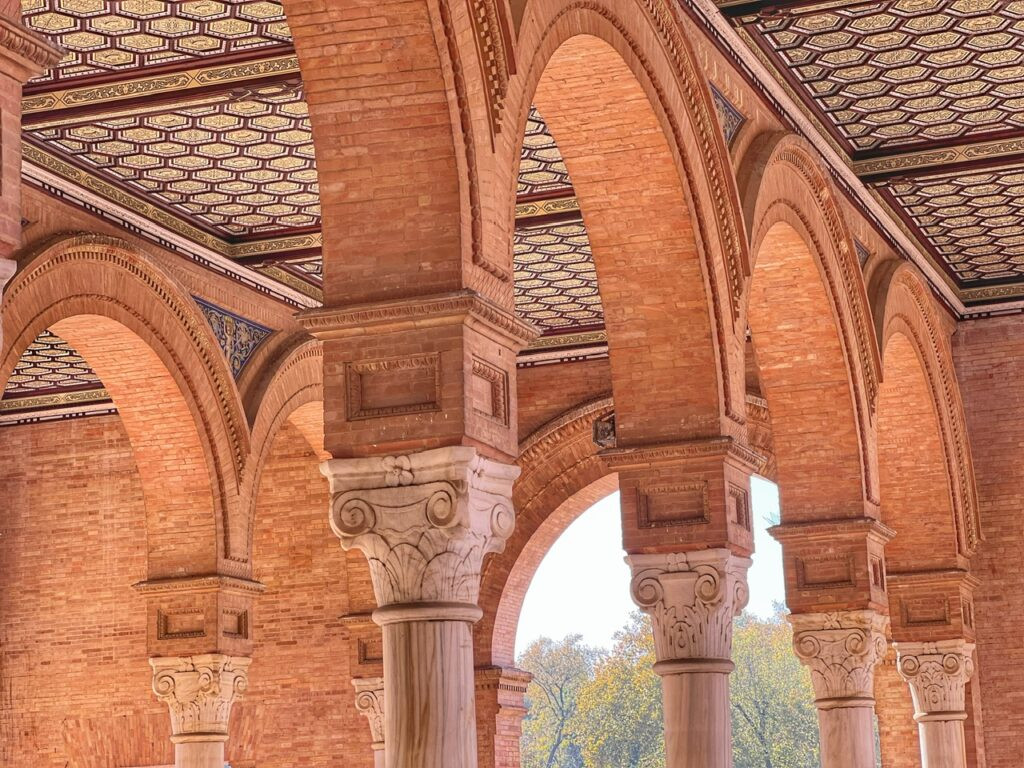
The architect was Aníbal González, who leaned heavily into “Neo-Mudéjar” and “Renaissance Revival” styles. Mudéjar is a uniquely Iberian Peninsula fusion in which spectacular Islamic design techniques kept living on under Christian rule.


And who could blame them?! The sweeping horseshoe arches, vaulted ceilings, lavish columns, and decorative tiles were clearly worth Xeroxing. Down to the embellished rain spouts, every element is simply superb. Also, like other places in Spain, they didn’t leave behind any opportunities to plaster their lead man Cristobal Colon (Columbus) on its facade.
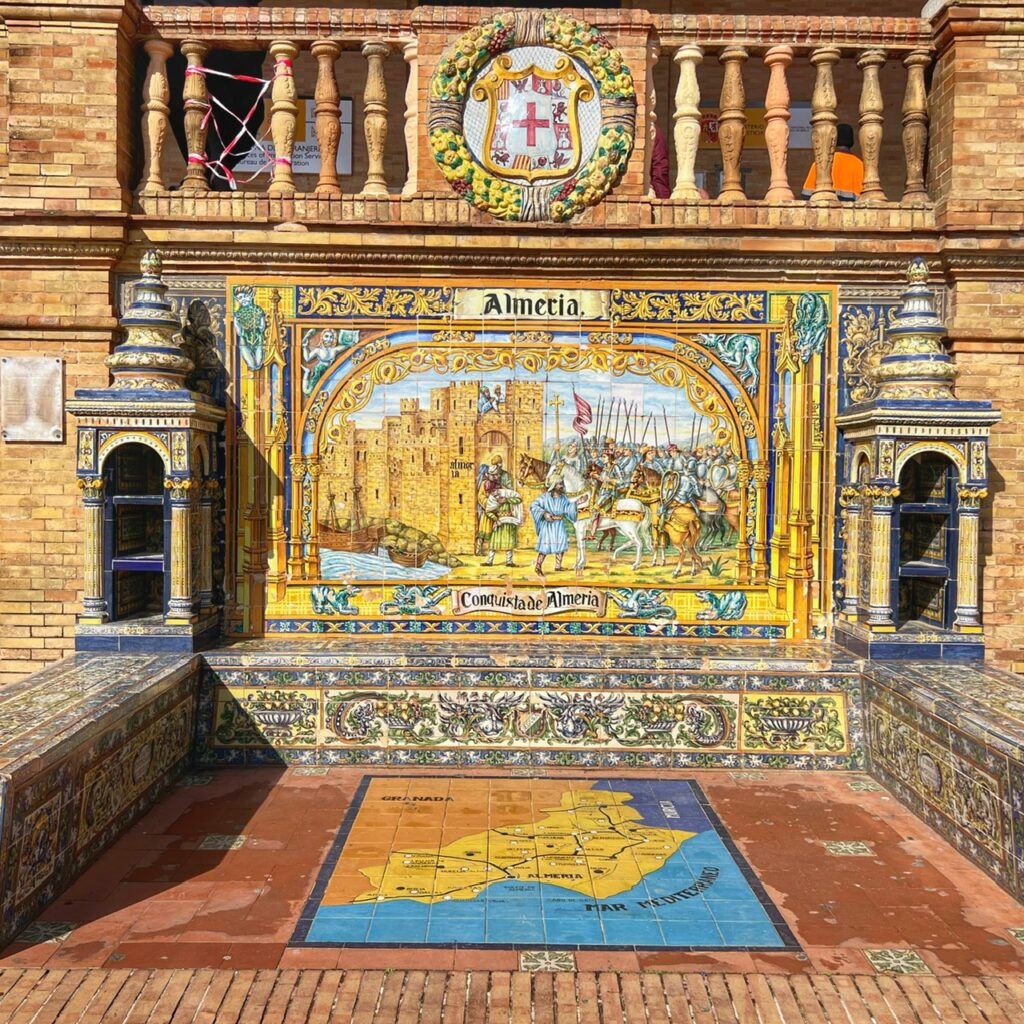
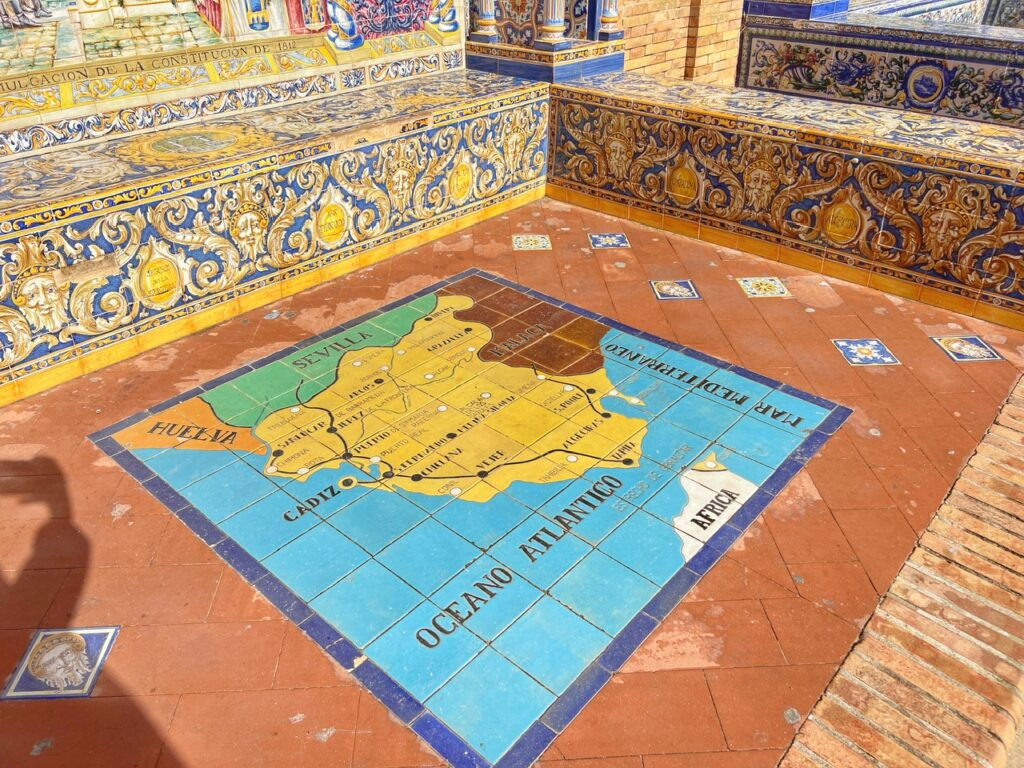
The plaza forms a semi-circle, which apparently symbolizes Spain “embracing” its former colonies across the Atlantic. (Side note: They had a weird way of doing it considering the Columbian Exchange brought horses and smallpox to the Americas while future French fries, aka potatoes and tomatoes, arrived in Europe. Needless to say, it’s easy to see who got the short end of the stick.)
Every perimeter alcove includes a painted map, the provincial coat of arms, and a historical scene. It’s basically a walkable, ceramic atlas and history book. It didn’t take us long to discover where we heading to next. Any guesses?
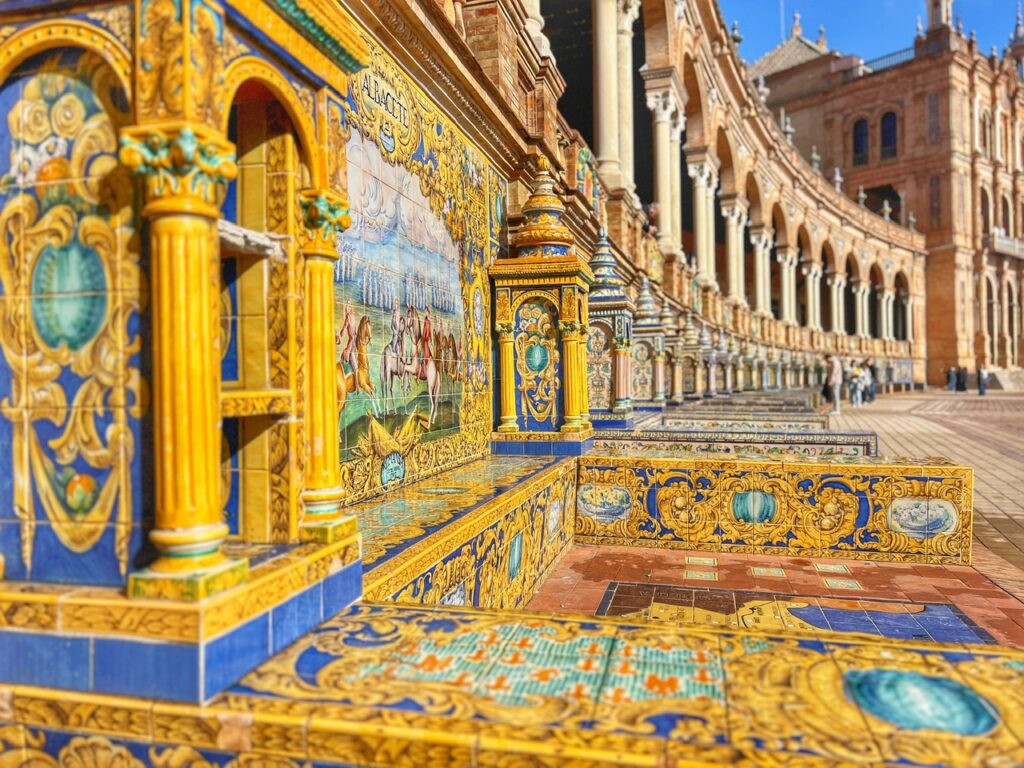
My rendition of the “influential” photo, though please, please do not ever call me an “influencer.” Hahah.
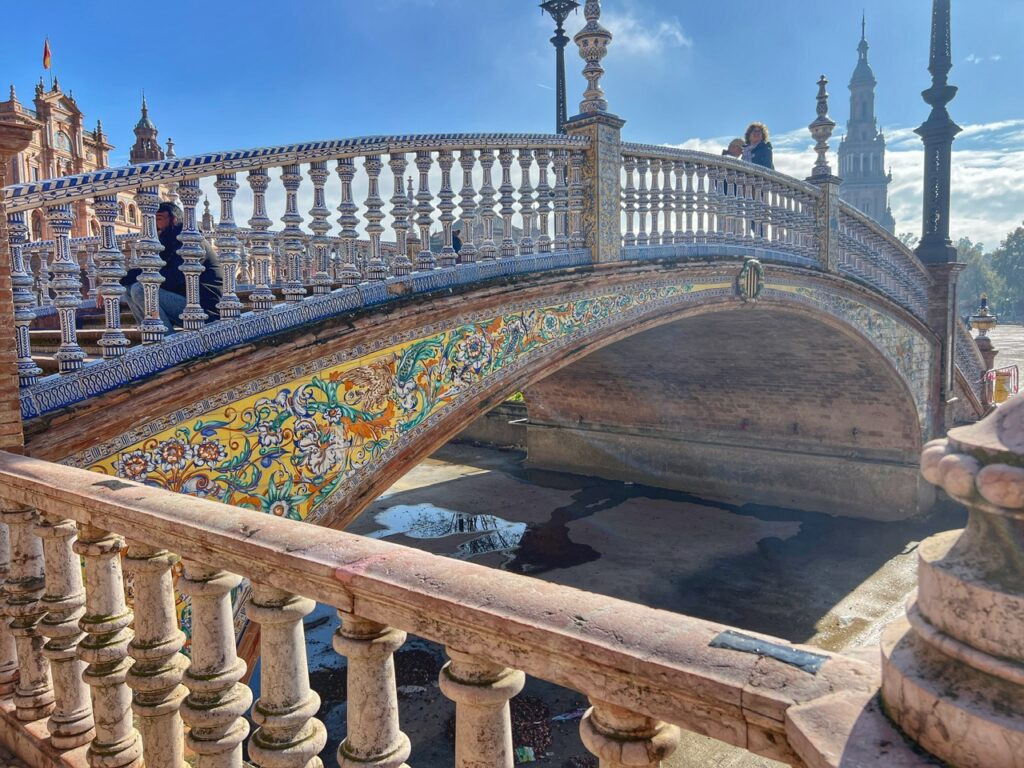

The canal that sweeps through the plaza can be crossed by four arched bridges, each representing one of Spain’s ancient kingdoms: Castile, León, Aragón, and Navarra. We were surprised to see it was empty.
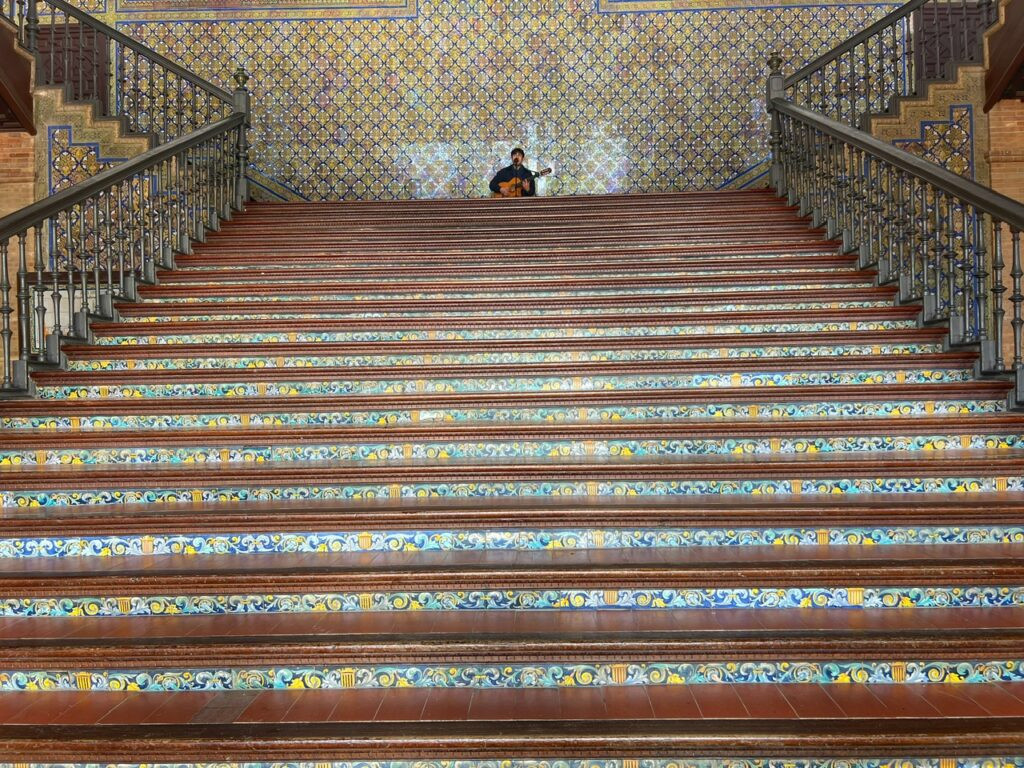
A grand staircase leading to the second level coated in mosaic tiles, accented by a symmetrically positioned busking Spanish guitarist, which led to an explosion of even more ceramic details.



Despite its splendor, the masterpiece wasn’t always appreciated as it should have been. Disappointedly, after the exposition, it fell into neglect and was even partially used as military offices. According to Chat, “Sevilla has a talent for under-appreciating masterpieces until time shames everyone into restoration.”
Fortunately, film directors noticed its potential long before city officials fully did, and it appeared in “Star Wars” (as Naboo), “Lawrence of Arabia,” and “The Dictator.” It seems futuristic space and old-world empires seek the same aesthetic vibe?

No matter what, it has serious curve appeal and is a truly monumental place
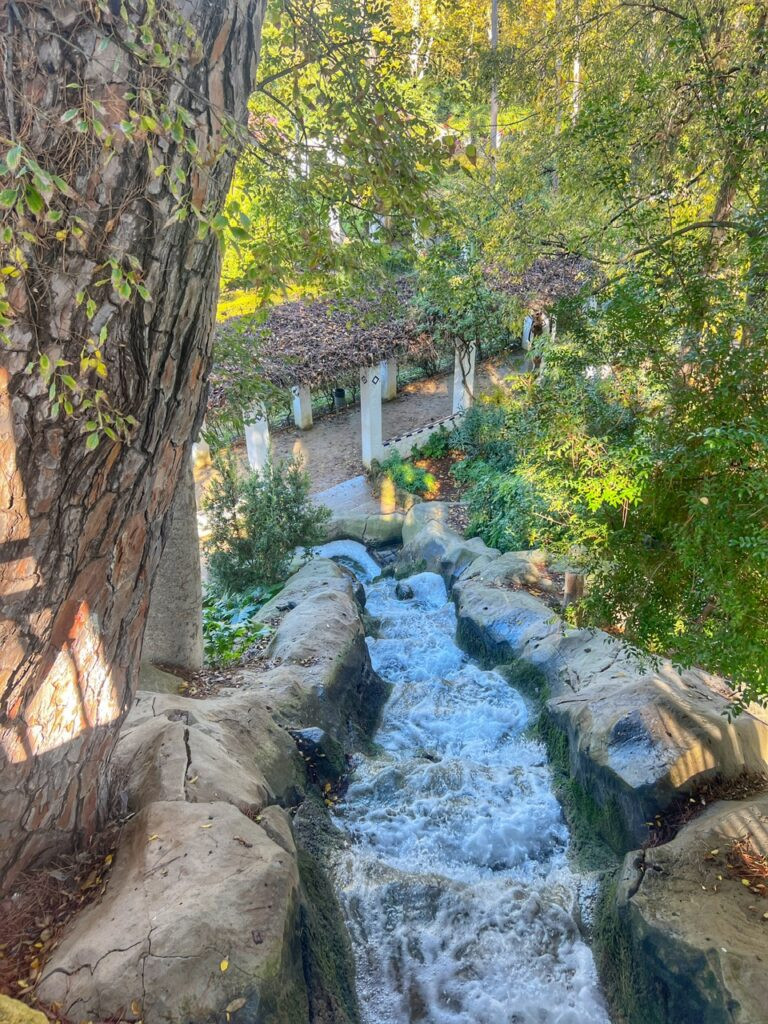
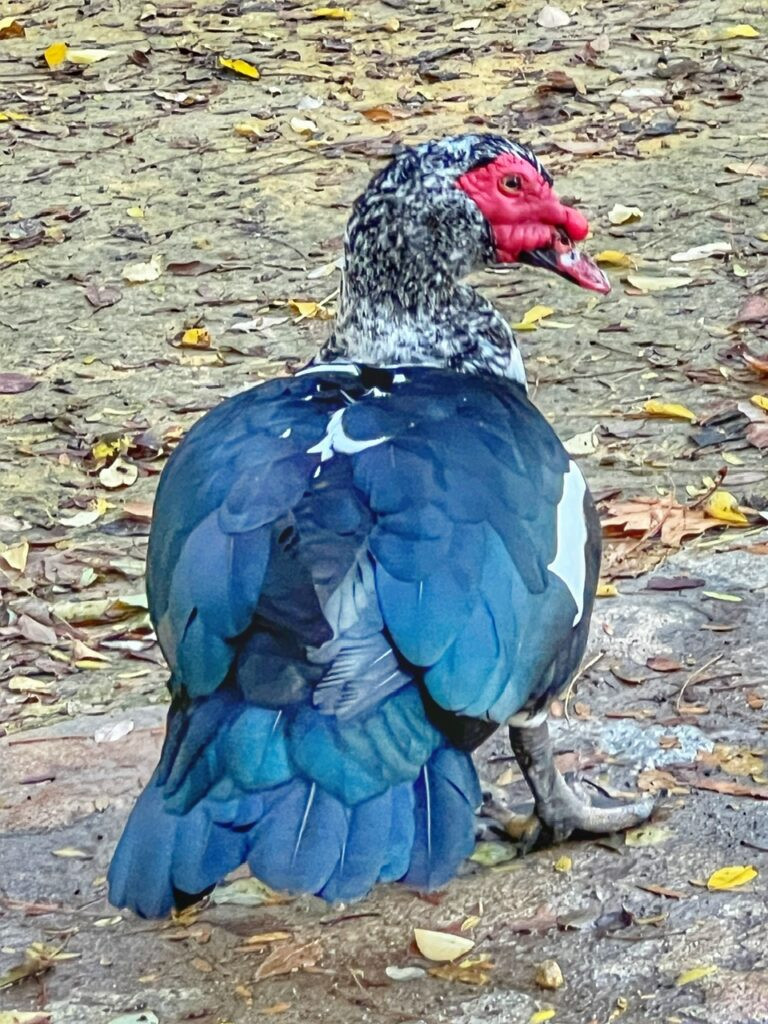
Delving further into Maria Luisa Park, which in itself can be wandered for hours, we stumbled upon Monte Gurugu, a mini artificial waterfall, and what was clearly a Columbian transplant, this strange coalescence of duck meets turkey is the “Muscovy Duck,” which is native to Mexico and Central America. Funny we should meet him here…
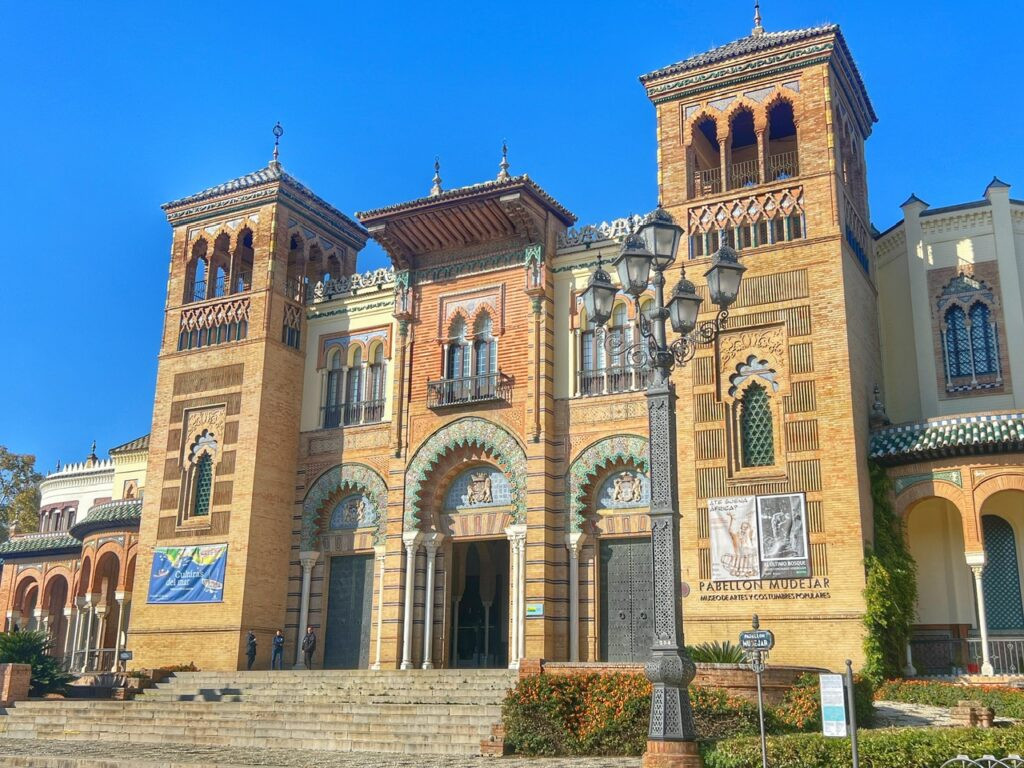
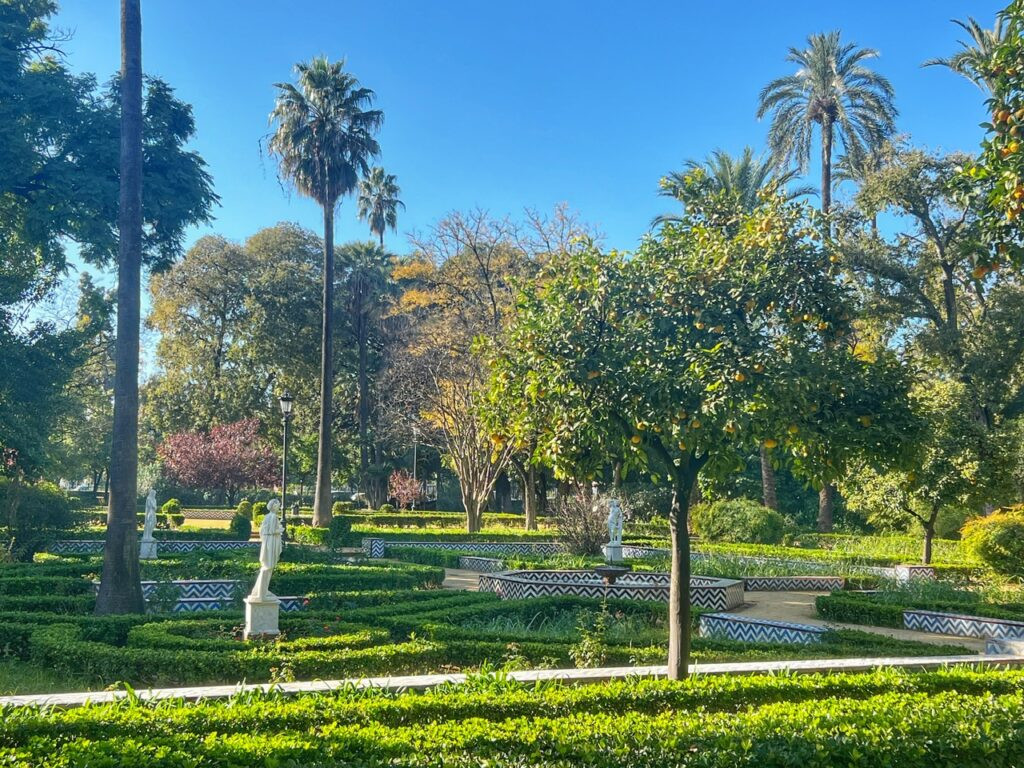
We also found the elegant Museum of Folk Art and Costume, and more manicured gardens than we could count.


