
Exploring the Ajuda Neighborhood
On our escape from Europe, we are passing through Portugal’s vibrant capital for four days. Surprisingly we had never been here so we decided to devote our time to discovering the city, and save Sintra and surrounding areas for another visit. We chose an apartment west of the center in the Ajuda neighborhood, which we noted looks a lot like “ayuda” in Spanish, and sure enough means “help.”
While we didn’t find ourselves needing any assistance, we were curious how it got its name. Apparently it’s because the neighborhood is perched on high ground, away from the river, which after the devastating earthquake of 1755 was literally life-saving. In fact, the royal family even flocked here, as well as many others. It literally became an area of refuge and assistance in both a physical and spiritual realm.
Here’s a few things we checked out in and around this area….

The chipper-colored Fabrica Sant’Ana is a window into the unique Portuguese craft of azulejos, or ceramic tiles. In this authentic working factory they make tiles nearly the same as they did when it was founded in the 1700’s. If you’re looking for a true ceramics experience, tour or souvenirs, and not touristy tat made in China, this is a terrific place to go.

Heading down to the Tagus River, we made our first discovery, at the “Monument to the Discoveries” from 1960. This unique landmark, cut like a caravel ship’s prow, sits as if slicing into the river on its way out to conquer some colonies. It was designed to glorify Portugal’s Age of Discoveries at a time when Portugal still clung to its colonies. Naturally, it neglects the enslaved people, indigenous populations and anyone on the receiving end of “discovery.”

The Tagus River, the artery that connects to the Atlantic Ocean is knitted together boldly by the April 25th bridge, in honor of the 1974 end of dictatorship. Yes, Portugal was under dictatorship this recently. The bridge strongly resembles San Francisco’s Golden Gate, minus the Christ the King statue welcoming commuters to the other side.

With a quite different appearance, the fortified medieval tower of Belem was bedecked in scaffolding. It once stood as the naval symbol to protect Lisbon’s harbor. According to Atlas Obscura, on it sits a rhinoceros carving, aka propaganda in stone, which was Europe’s first stone depiction of one, tied to Portugal’s Indian Ocean trade.


On another day, we wandered into the LX Factory, which is a revitalized industrial complex now serving as a trendy place to drop some dinero, grab a drink, or soak in some art. The vibe is gritty, grungy and social, which for us, felt like a distinct throwback to our former home of Portland, especially because it’s tucked under a bridge. Like places in the Pacific Northwest, it also accelerated gentrification upon its development.


The view from the LX Hostel’s rooftop bar, where we flocked with many others to catch the last bit of Vitamin D and some overpriced 5 € glasses of Douro Valley vino.


It also appeared to be family friendly. Speaking of, Lisbon-born artist Artur Bordalo makes numerous statements with his large scale sculptures made entirely from trash. This piece is about family overconsumption, plastic waste, and the fact that even objects tied to innocence and childhood become garbage fast.


Alongside this, you’ll still find plenty of places to shop at LX Factory. No chains for sure, but according to the signage, you’ll find 33 concept stores, as well as plenty of posh places to suck down some sangria or vino.

The entrance to the complex

A street scene in our neighborhood

The ultra modern MAAT…Museum of Art, Architecture and Technology, which costs a steep 15 € to enter.

We still got a piece of Portugal by checking out supposed “original” natas at “Pasteis de Belem” for 1.60€. If there’s one Portuguese food item you might know, it’s most likely the country’s renowned egg tarts, or pastel de nata. Served warm, these were probably the best ones we ever had.
According to Atlas Obscura, “legend has it that the sweet—which consists of pastry cups filled with an egg and cream custard—was probably first baked at the neighboring Jerónimos Monastery. When Portugal’s monasteries were closed in 1834, a former monk/baker moved shop to a sugar refinery a few doors down, and in 1837, the confection known today from Portugal to Hong Kong was born.
Today, there are several brands selling custard tarts in Lisbon, but Pastéis de Belém continues to be a family-run company with no branches or franchises. The tarts are only available at the original location in Belém. As many as 20,000 are baked here every day following the original recipe, the fillings of which are mixed in a “Secret Office” where the precise ingredients and proportions are measured—details said to be known by only seven humans.”

Our Airbnb room for five nights set us back $50/night, which is obviously not the ideal way to start our budget in the new year. It’s a private room, with a shared bath and kitchen, which we’re sharing with a French guy and a Kiwi couple. Oh…another amenity is its heatlessness. Yes, we’re still freezing in the single digits every night.

It’s easy to understand why we were soaking in every last bit of sunshine we can. Por favor, get us off this continent.
Exploring the City Center
We’ve heard from several people that Lisbon lacks a little something-something when compared to its darling northern sister of Porto. And we have to admit, it lacks a little luster to us as well, which is not surprising to us “non-city” people. However, for those that enjoy a bit more sprawling action and big city buzz, this picturesque port might be right up your alley. It does seem to offer a lot more sunshine…and possibly even more psychotic seagulls….
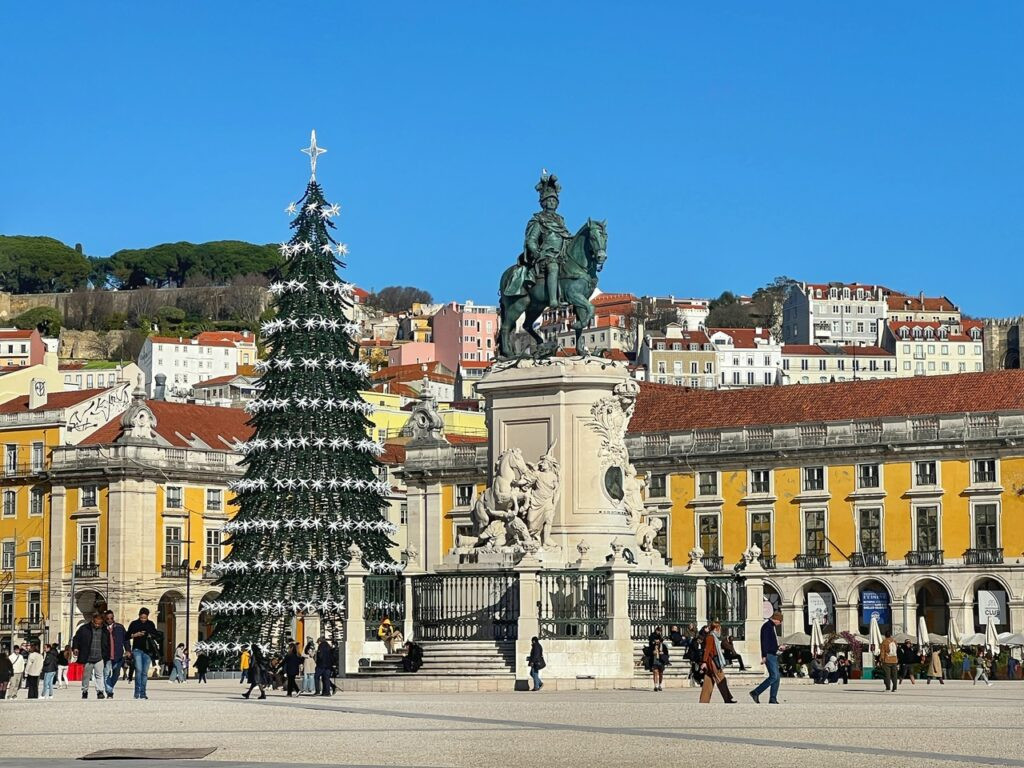
At first glance you might think the grand riverside Commercial Plaza packs all the elements of a classic European holiday scene into one punch. You then realize the church/bell tower, market stands and dismal grey skies are missing. This latter part… we definitely appreciated.
What is lacking to us is the widespread “cute” factor of other European cities. The Portuguese attribute this to a magnitude 9 earthquake that devastated the city in 1755. This said, you simply have to look a little harder for the pockets of cuteness

Established in 1732, Bertrand bookshop is the oldest operating bookshop in the world and has the Guinness Book of World Records signage to prove it.

Instead of having a Red Light District, Lisbon offers a tamer Pepto Pink Street, which was revitalized ten years ago and now just offers a vibrant nightlife scene minus the blatant twirling tatas. Not to worry…it seems there are several strip clubs still available if that’s your thing. Considering our presence at 10:30 on a Tuesday, we only witnessed the twirling of the orange-vested street sweepers which really do a lot for either one of us.

Throughout Lisbon, you find dozens of adorable 19th Century kiosks which have stood the test of time, and likely lots of drunkenness. Near Pink Street, this is one of the few that are privately owned.


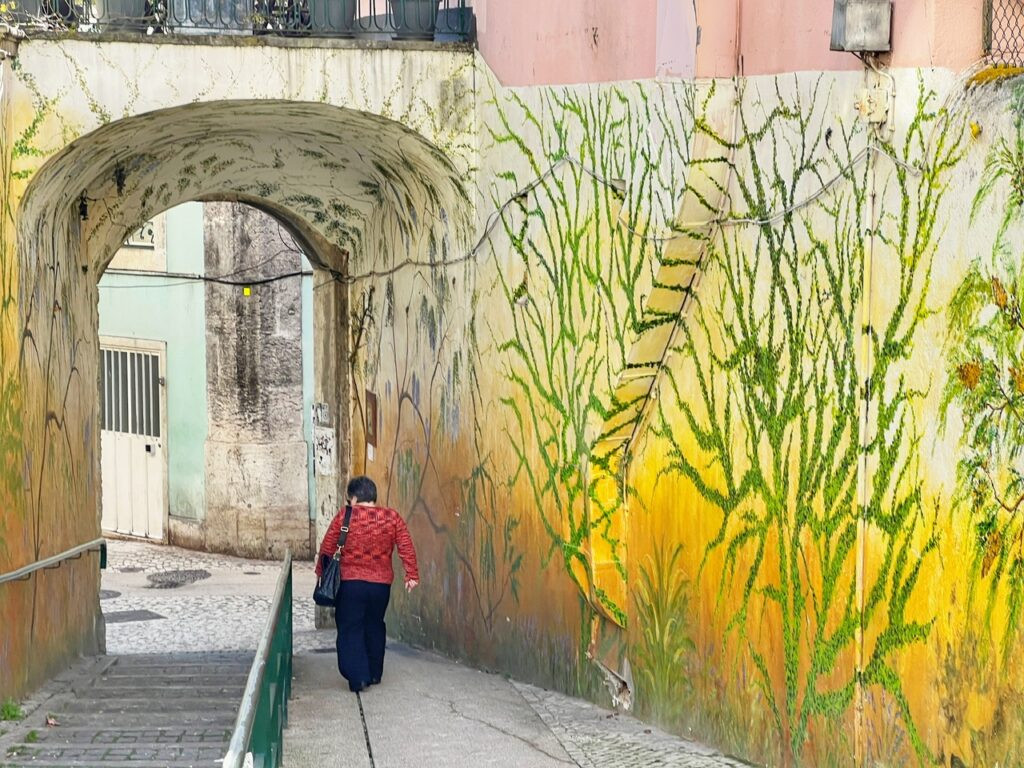
Canvas on a casa. Lisbon, like Porto, is quite steep and getting up to any mirador will take some gluteus maximus power.

As we wandered the city streets, the mirador we chose was “Miradouro da Senhora do Monte” which featured commanding views of the many geological lumps of the city, (7 to be exact), including the one with the quintessential fairy tale looking castle.

Another striking piece by Vhils, which we first rubbed elbows with in Porto. His creative destruction involves chipping off areas of a wall to reveal the many layers of urban history. Given the subject matter of a Muslim woman, the exposure of under layers feels particularly poignant.

The historic Tram 28 dates back over a century to 1914. Although it seems like a unique, albeit appropriately sardine-esque manner to see the precipitous hills of the city, our legs were functioning fine and the two-block line to board seemed pretty ridiculous.
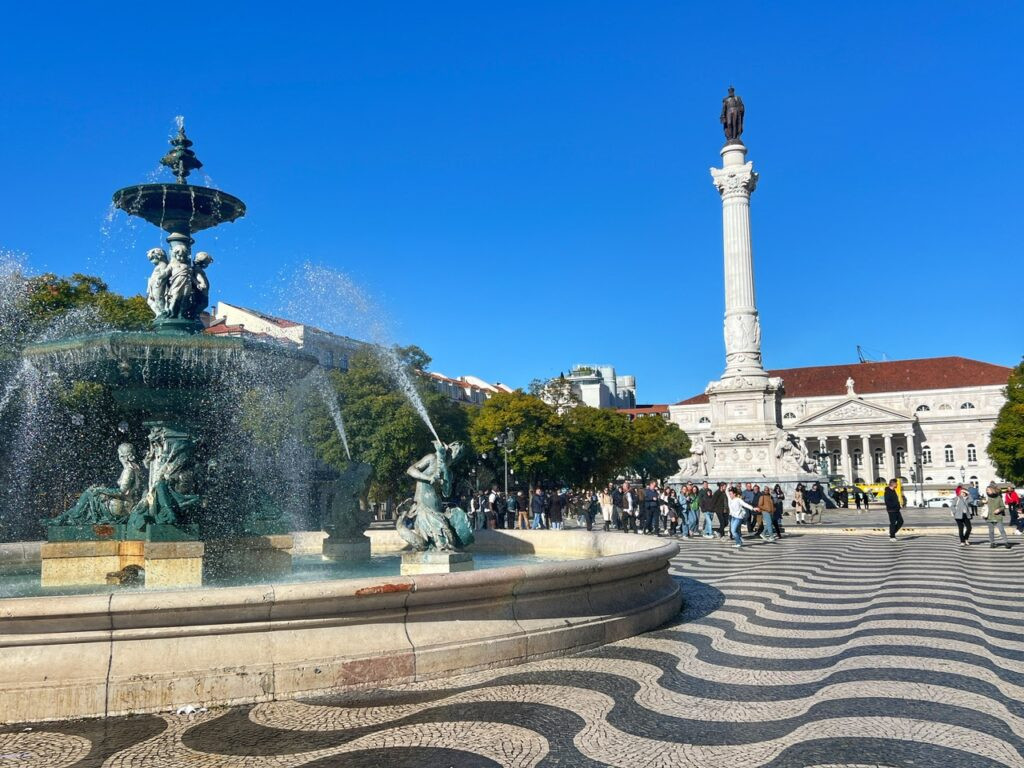
Plaza Dom Pedro the IV, who must have been into surrealist based on the tiles beneath.


The elegant Santa Justa lift dates from 1902 and has been facilitating the 45 meter climb from the Baixa Pombalina to Barrio Alto since it was built by one of Gustav Eiffel’s students. It is currently out of operation.
Behind the lift, a pretty and plum-my lady somehow makes a dust buster look sexy. Her name is Sophia and her Portuguese creator, Superlinox, suggests she’s open to interpretation and to enjoy the humorous contrast of an everyday object in a public, historic spot.
Without taking the lift, it takes about 10 minutes to truck up the hill for a fantastic view of the elevator’s structure and surrounding castle crowned hills.


As you walk through the streets or Lisbon, it’s common to find vintage cars and trucks, typically used as tourist gimmicks. This one was selling Fado CDs and cassettes though god knows if our the 21st century generations would know what to do with them.
A peaceful square and another historic kiosk near the top.
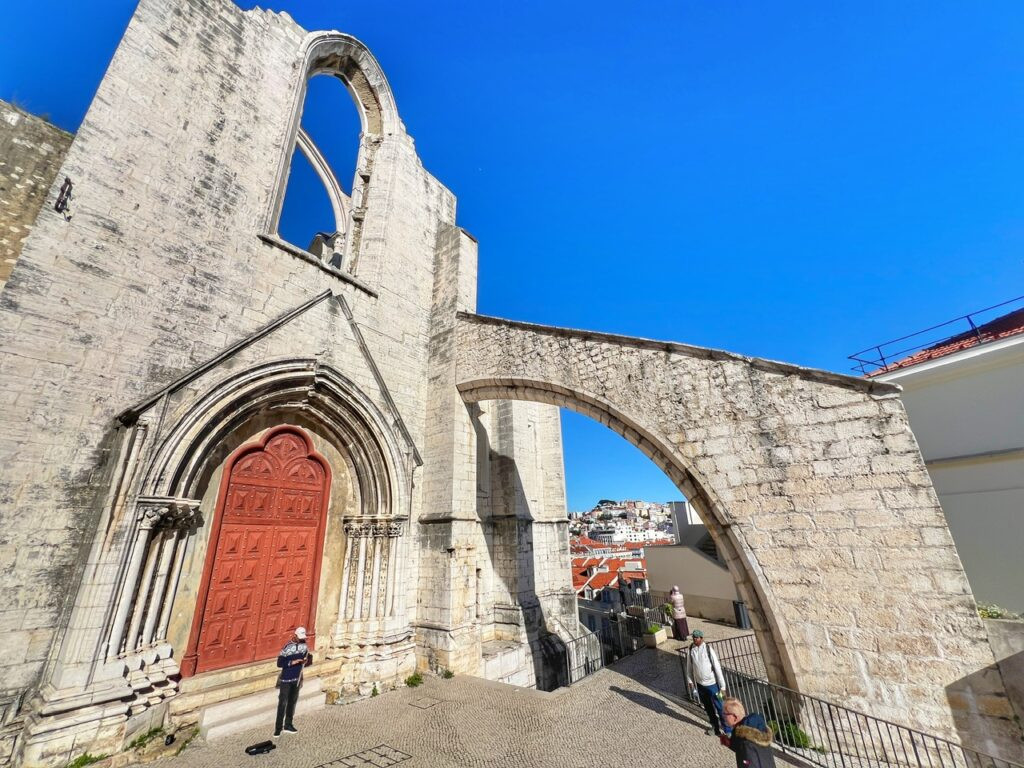
The ruined arches and flying buttresses of the Carmo Convent are a constant reminder to the Lisboans about their worst day in history…when the earthquake, a series of tsunamis and five days of raging fires left 85% of the city in total ruins and killed upwards of 100k people.

The bustling pedestrian thoroughfare called Augusta Street where you’re guaranteed to have several menus with photos thrust in your face. Their Christmas lights depicting clouds and raindrops are a bizarre choice.

Classic Lisbon. Our Brazilian housekeeper, Mary, said riding these trams everyday are one of her favorite parts of living in the city. Other than this, she said she’d prefer to live in the north where it was more charming and felt more like her home in Minais Gerais.

Greg and I enjoying our Too Good to Go Indian lunch, which we got for 5 euros, on the waterfront.
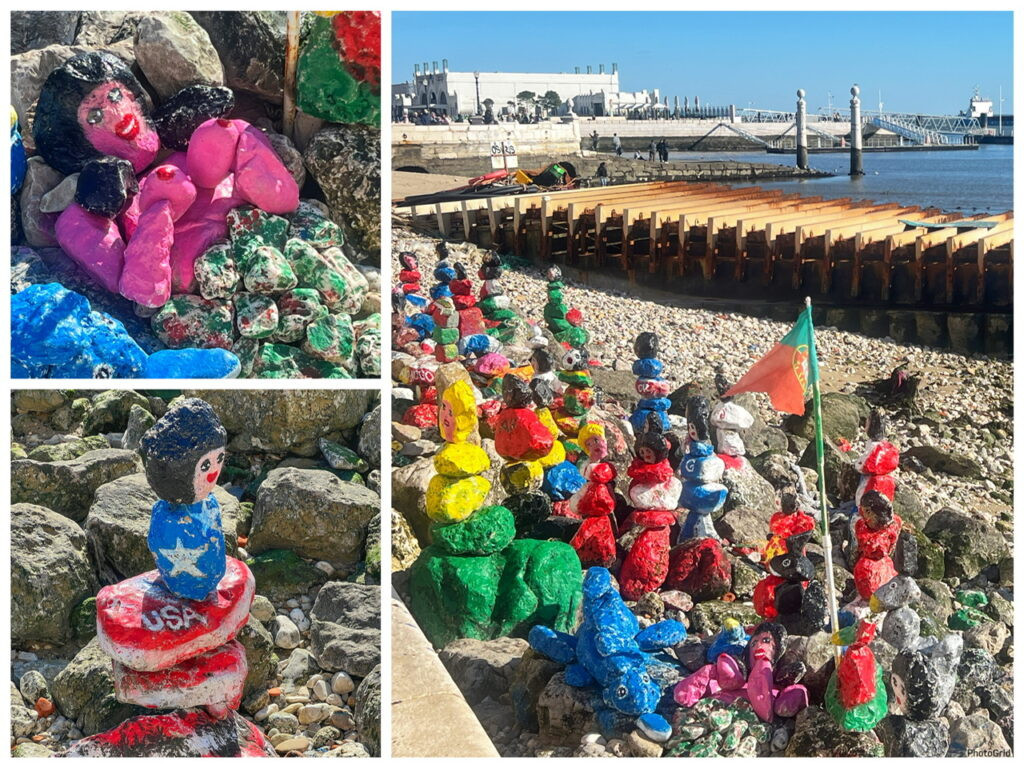
Afterwards, we checked out the Painted Rocks, which seems to be an eclectic blend of various UN members and other creatures. The American funnily looked quite Asian, and was surprisingly not obscenely grafittied, while the prominently breasted mermaid looked like she was a few blocks off from her home on Pink Street.

Peeking inside one of the many opulent pastry shops.


Our favorite part of Lisbon was undoubtedly Barrio Alto, a steep and narrow cluster of cobblestones, which had a silence and solitude that immediately cured our already vulnerable nerves from the city.


Another claim to fame in the old department…the oldest candle shop, Casa das Vellas, which has been in business since 1789. Of course, nobody cares about the candle shop. And EVERYBODY cares about the historic tram. To get this photo, we had to dodge several Instagrammers which seemed to be permanently positioned in various poses. It really makes you miss the days of cameras with film in them.

In seek of a quiet refuge again, we ducked into the public library, which had some wondrous treats of its own, including a large table filled with male….and female condoms. Make sure to grab one before you hit the stacks! 🤣

More eye candy.
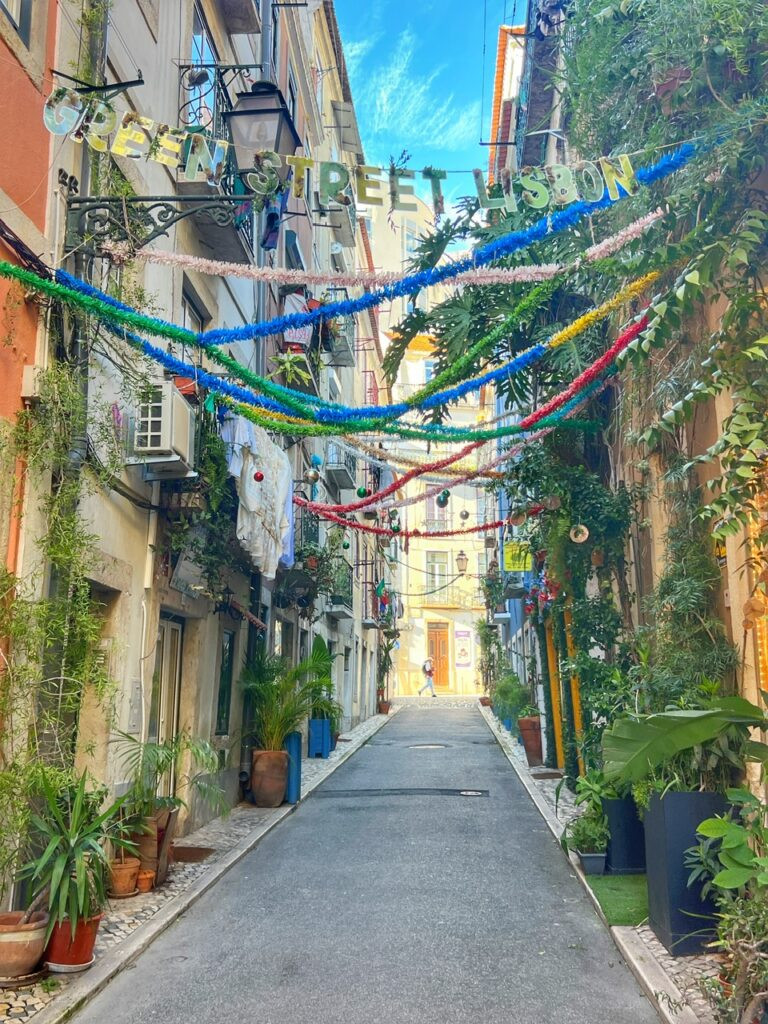
There were notably no parks in the old town area, but there was a “Green Street” which made an effort to bring some lushness in.


