
Despite being next door neighbors, the train experience in Bosnia & Herzegovina versus the train experience in Serbia could not be more dissimilar. In Serbia, everything is now easy, modern and requires little effort. Here, it’s a bit more convoluted, vintage and backpacker-y, despite the tremendous potential for train travel in this mountainous and beautiful terrain.
Why? The war was a big factor of course, which destroyed hundreds of bridges, tunnels and tracks, and other than the iconic Sarajevo/Mostar line, hasn’t been a big priority to repair.
Another major issue…. Bosnia’s complicated political structure. The country has two largely autonomous entities: The Federation of Bosnia and Herzegovina and the Republika Srpska, each with their own independently run and non-integrated railway companies.
That said, definitely don’t expect to find schedules or ticket purchases available on a conveniently downloaded app. You have to go to the railway website which is equally as janky with no search options.
We presume this is why a lot of tourists end up taking the bus, which is sort of a shame considering it costs four times as much, and isn’t nearly an interesting experience. Needless to say, we were excited to jump aboard the 8:17 train for our day trip to Visoko.

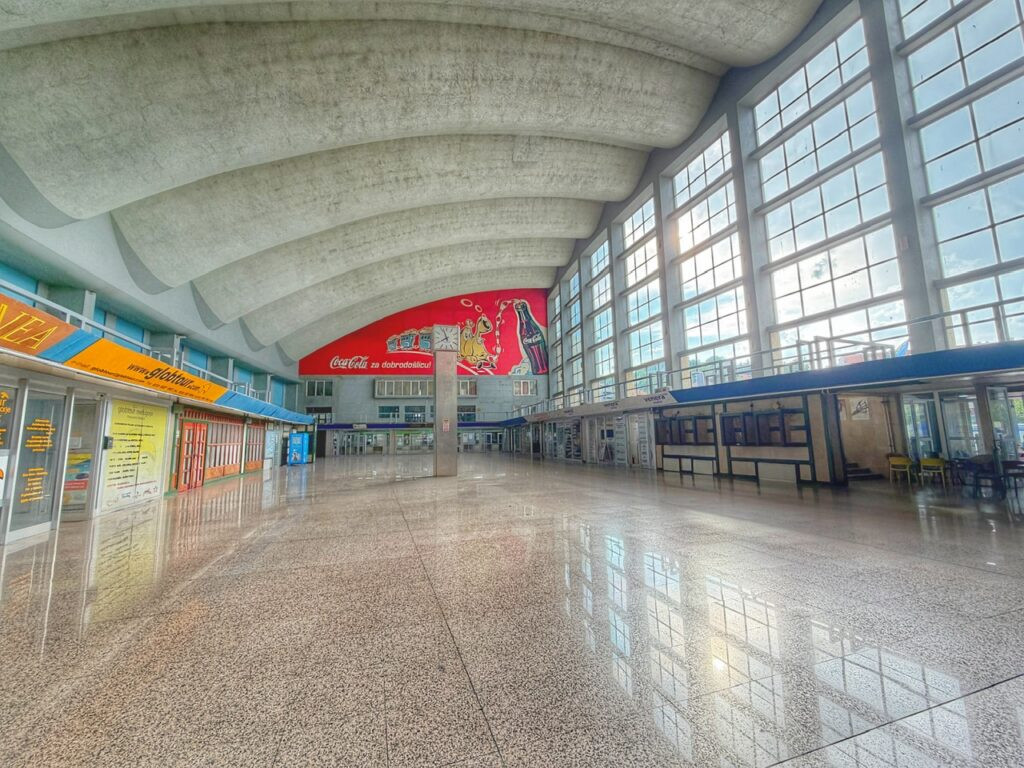
The stark station itself is an undoubtedly a nod to the Yugoslav past, built in 1953. Back then, it served a significantly larger network and was bustling with life.
Today, it’s completely desolate inside. No people. No schedules. No benches. Frozen in time complete with a flashback Coca Cola ad accessorizing the wall. Thus, we were shocked to see a lone (but friendly) woman behind the ticket window, who proceeded to tell us to buy tickets on the train, completely negating the value of her job.

Shortly after, we found a quite small, confusing schedule which, after some Google Translation and puzzle decoding, informed us the next train at the station would not leave for an hour and forty-five minutes, which meant the lone Grafitti Wagon on the platform must be our ride.


The inside surprisingly was not infested with vinyl bench school bus style sweat sliders, but perfectly adequate cloth ones for our 45 minute ride. We think about 4 other people were on the train with us.

Settling in, we paid the conductor about $1.50 each (Ummm. Yes, shockingly cash only) and proceeded to observe some perplexing signage. Does this mean it’s ok to throw your bottle of rakija out the window? Also, what’s with the foam?

Out the window, more signs of yesterday in a giant and crumbling vacant factory.

Before you get off any train, it’s generally a good idea to use the facilities because you never know when the next opportunity will present itself. This opportunity allows evacuators the chance to give back by watering and/or fertilizing the track.
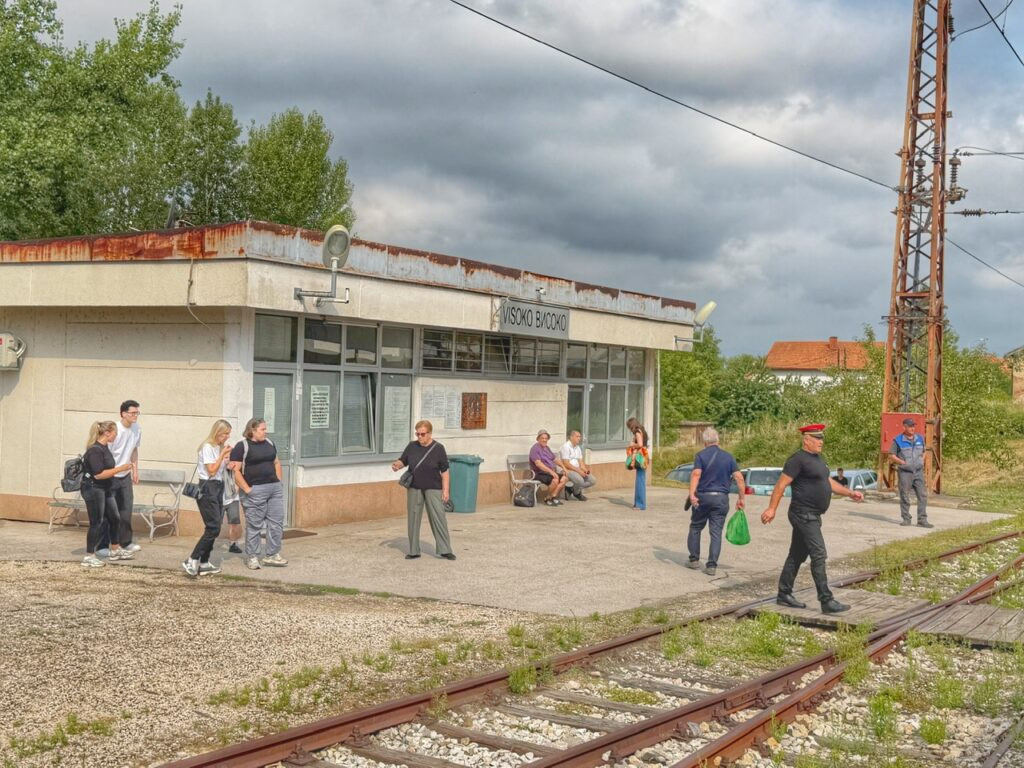
Arriving to the station in Visoko….what a sight!
Visiting the Bosnian Pyramids
Upon disembarking from our train experience, we had landed in the Visoko Valley, home of the Bosnian Pyramids, the alleged oldest and largest pyramids….in the world. Never heard of these 33,000-year-old architectural marvels? You’re not alone. In fact, many people that visit Bosnia & Herzegovina don’t even know about them! And yes, if you’re still scratching your head, you read that date right…33,000 years…making them…oh…28,500 years older than the Egyptian pyramids.
Whether you think they’re an ancient wonder or simply fascinating hills….there’s no denying they’re an interesting, albeit peculiar site to visit.

There are supposedly five pyramids and pictured here is the tallest…the Pyramid of the Sun, which faces cosmic north, and supporters say is about 220 meters (720 feet) tall, which means it soars more than 75 meters above the Great Pyramid of Giza. Seriously. Think about this.
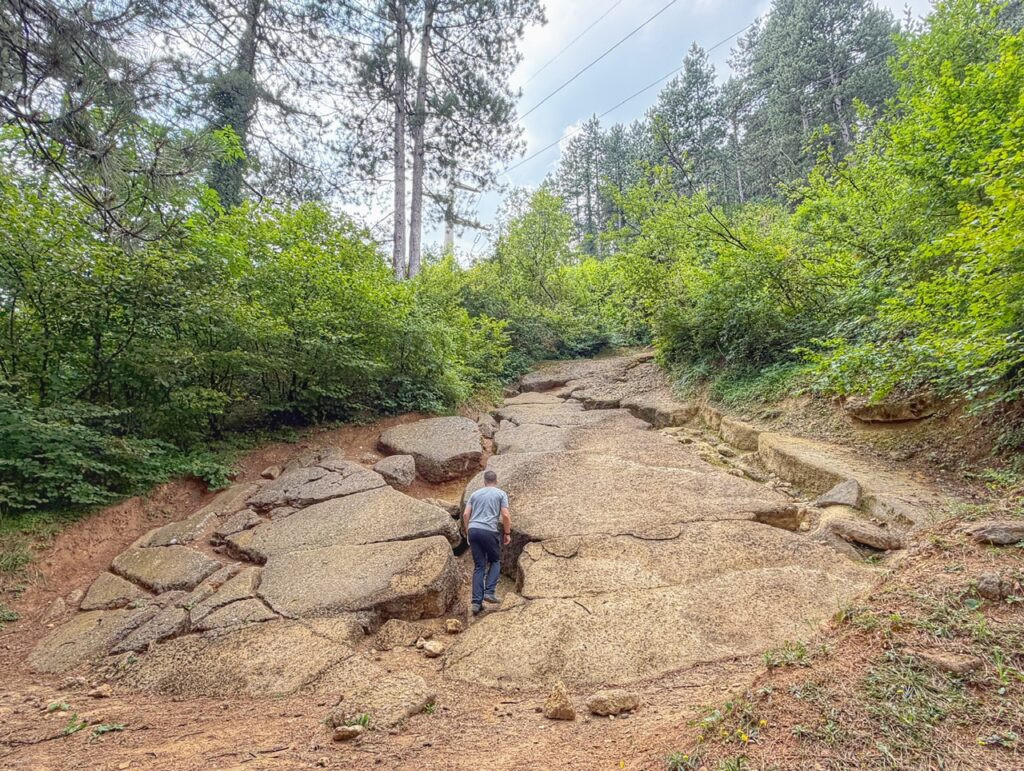
The spectacular views heading up the pyramid, which you can access with a guide for 5 euros. Also, Greg, climbing up one of the more credible sections, which has been excavated by volunteers since its “discovery” in 2005.

We confirmed the stone underneath is quite clearly….concrete, which according to a nearby plaque “pyramid builders used rocks, pebbles and sand from underground tunnels, and as a binder, melted clay. This concrete is harder (55 MPs) than modern concrete with lower water absorption (1%).”


Also, according to plaques, it’s the “best quality concrete in the world.” Well, I’d say so considering it’s 33,000 years old!
Other plaques proclaim…
“Bosnian Pyramid of the Sun was discovered by the anthropologist(?) Dr. Sam Semir Osmanagic (a Bosnian-American amateur archeologist and businessman…note the second career choice) in April 2005 while visiting Visoko and the local museum for the first time. Even though the pyramid was covered by soil, bushes and forest, he noticed regular four-sided pyramid geometry with the four corners. The compass showed perfect side orientation to the cardinal points: East-West.”
Following this, Osmanagic managed to get funding and permission to begin geological core drilling, archeological trenches and lab analysis. He then recruited hundreds of volunteers to become the most active archaeological site in the world, claiming that it was built by an advanced prehistoric civilization.
Mmm….ok. He also says there are four other pyramids, which generate perfectly straight lines.
And then tossed some more geometry at nearby Ravne, a network of “ancient” underground tunnels to “prove” they were also connected to the pyramid complex. While these tunnels are very real, more likely, they were used as mining tunnels (says Atlas Obscura). Also, both the tunnels and pyramids are said to have some very unique energetic properties. I can usually pick up on that kind of thing, and for the record, I didn’t. 🤣
Unsurprisingly, almost every professional archeologist and geologist disagrees and has strongly criticized his claims. Their main objections are..
- The hills match known natural geological formations
- There is no convincing archeological evidence of construction
- No artifacts, inscriptions, settlements or tools have been found to support an advanced prehistoric pyramid-building civilization.
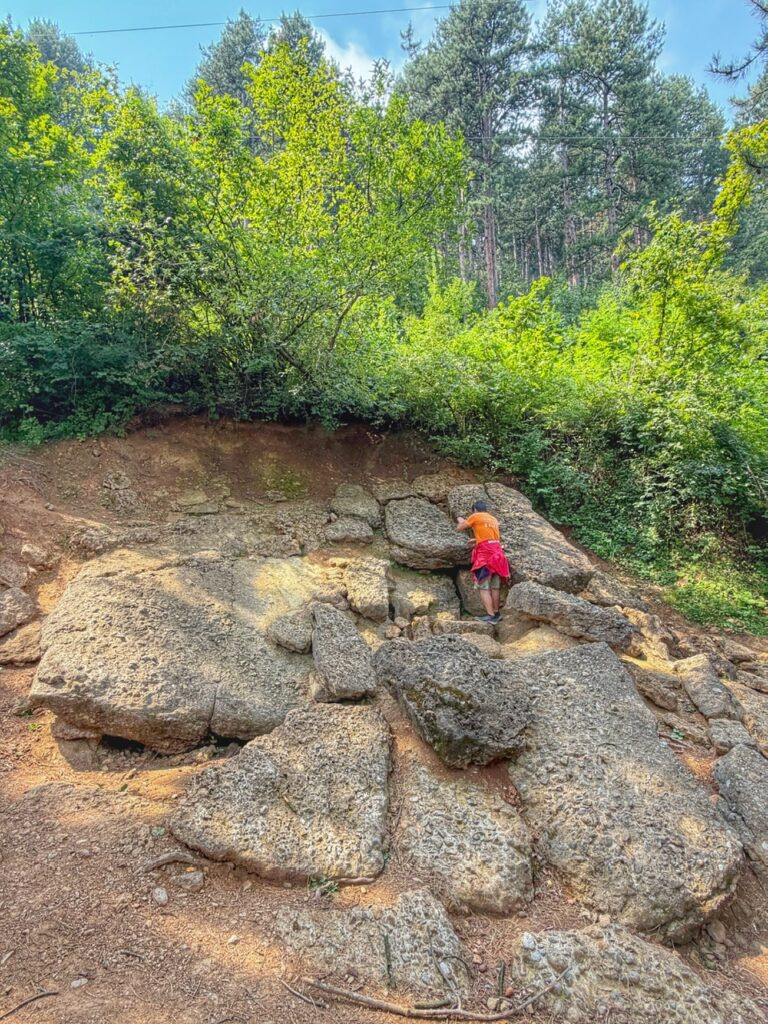
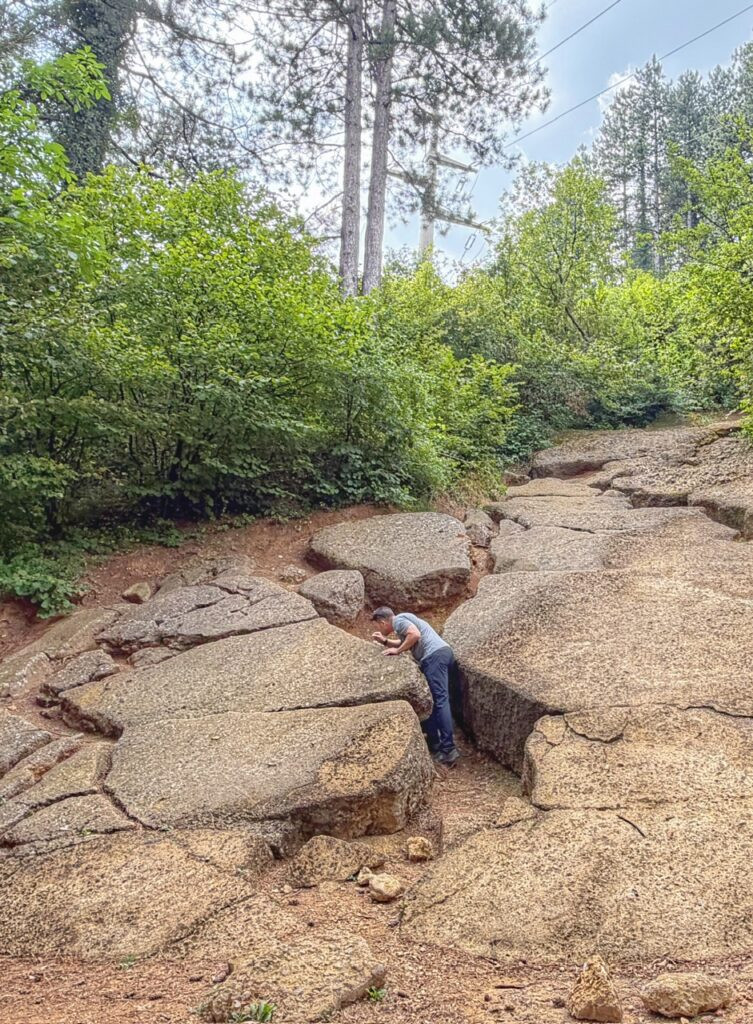
Regardless of the debate, Osmanagić has still brought international attention, jobs and tourism to Visoko. Greg, the rock jock, making his own conclusions. Apparently this is simply the kind of place you’ll need to decide for yourself…?
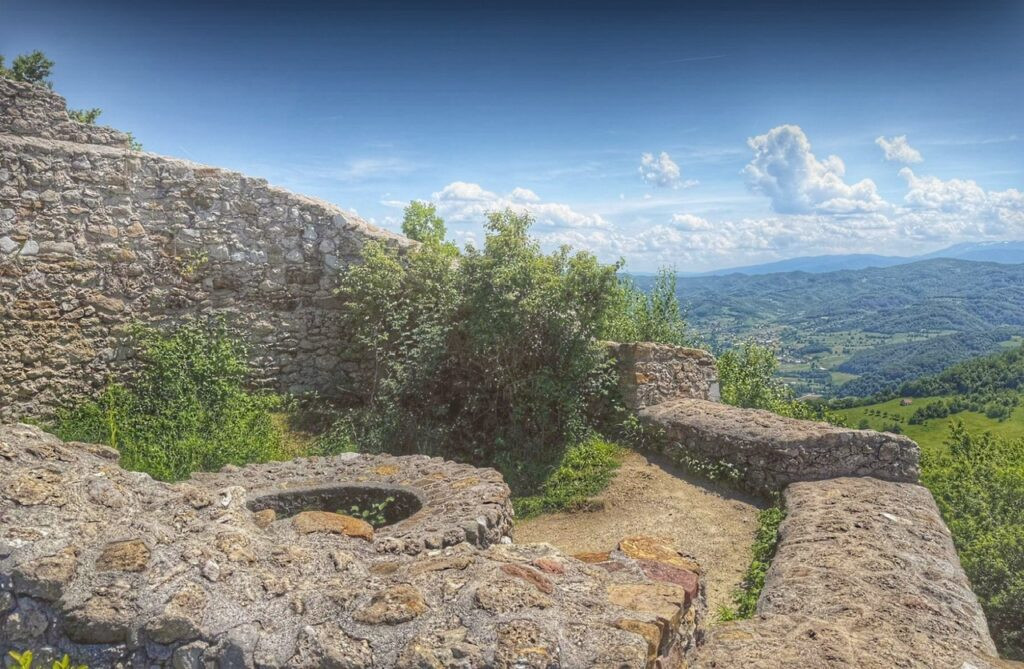
All that said, it was worth the story, the mystery, and gave us the opportunity to climb about 15 minutes further to a legit medieval ruined fortress at the top.
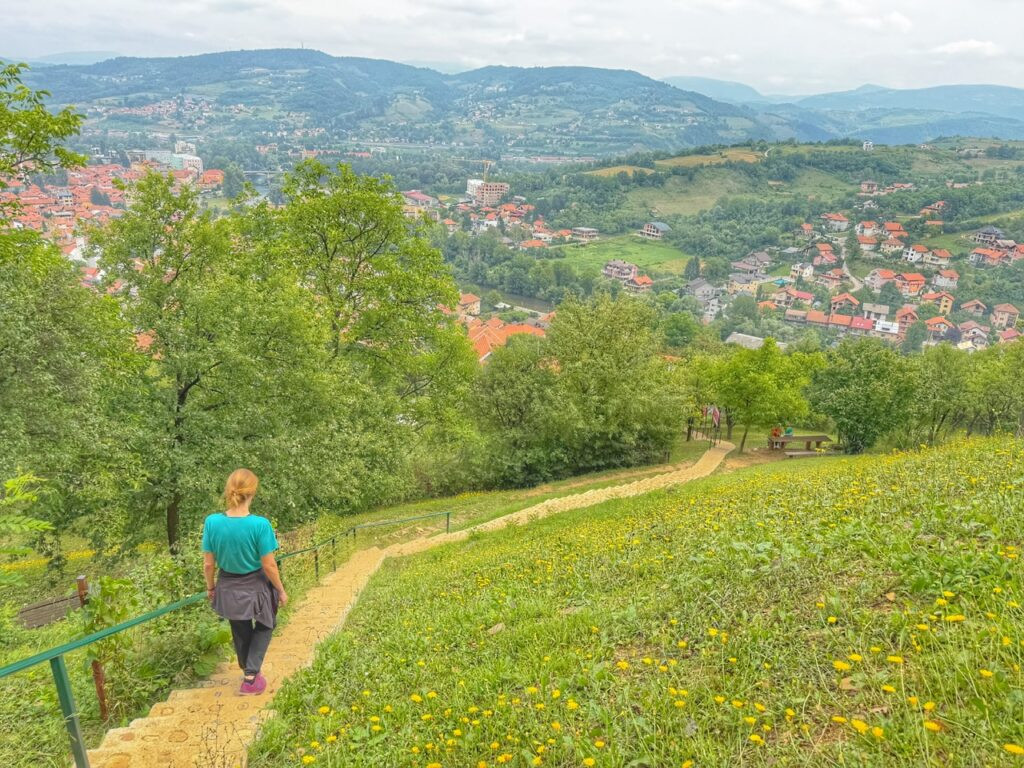
Descending the great pyramid.
Checking Out Visoko

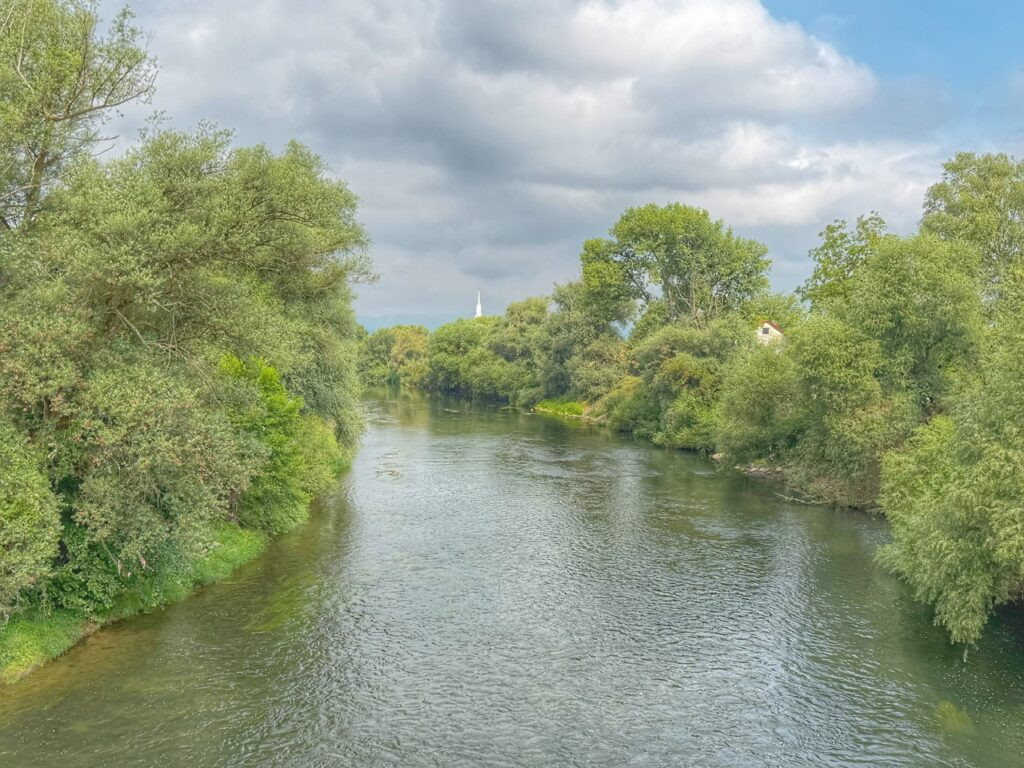
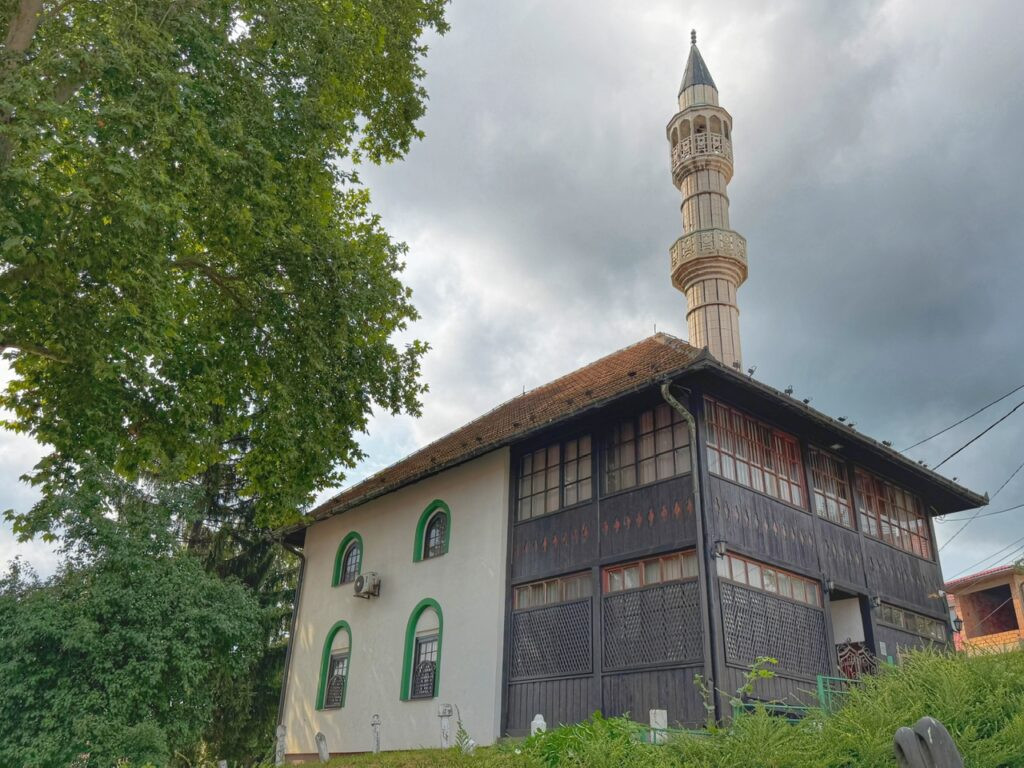
Back in the town of Visoko, we admired other views, which included several mosques.

However, we’d certainly never seen one like Šerefudin’s White Mosque, a striking 1969 modernist version which defies architectural conventions, according to Atlas Obscura.
With the “upside down” staircase, it has the aura of optical illusion images I used to cross my eyes over as a kid, and is further enhanced by a crowning of green pipe webbing and a random ladder to nowhere. Could it be the inspiration for an Islamic edition of Chutes & Ladders?

The great pyramid from the town of Visoko…


…which was bedazzled by picture perfect roses. And soon….on our way to lunch, not-so-picture-perfect drops began tumbling from the sky.
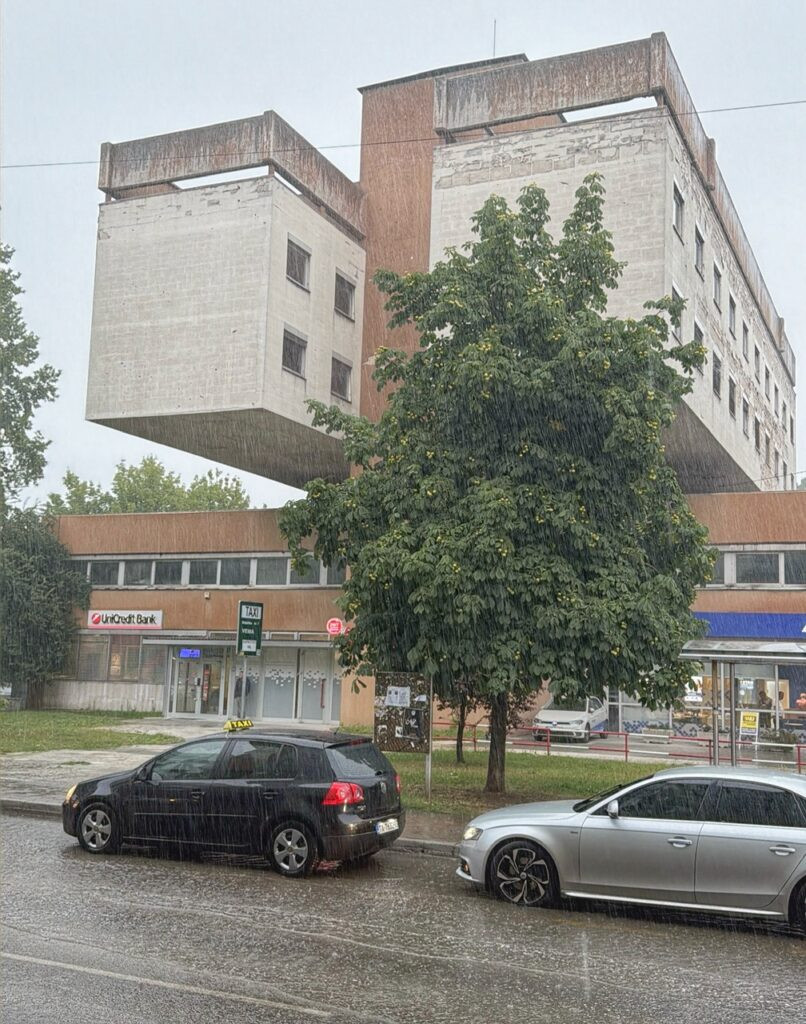
In fact, they were downright obnoxious, as we hovered under an awning near a building clearly constructed by a Lego architect.
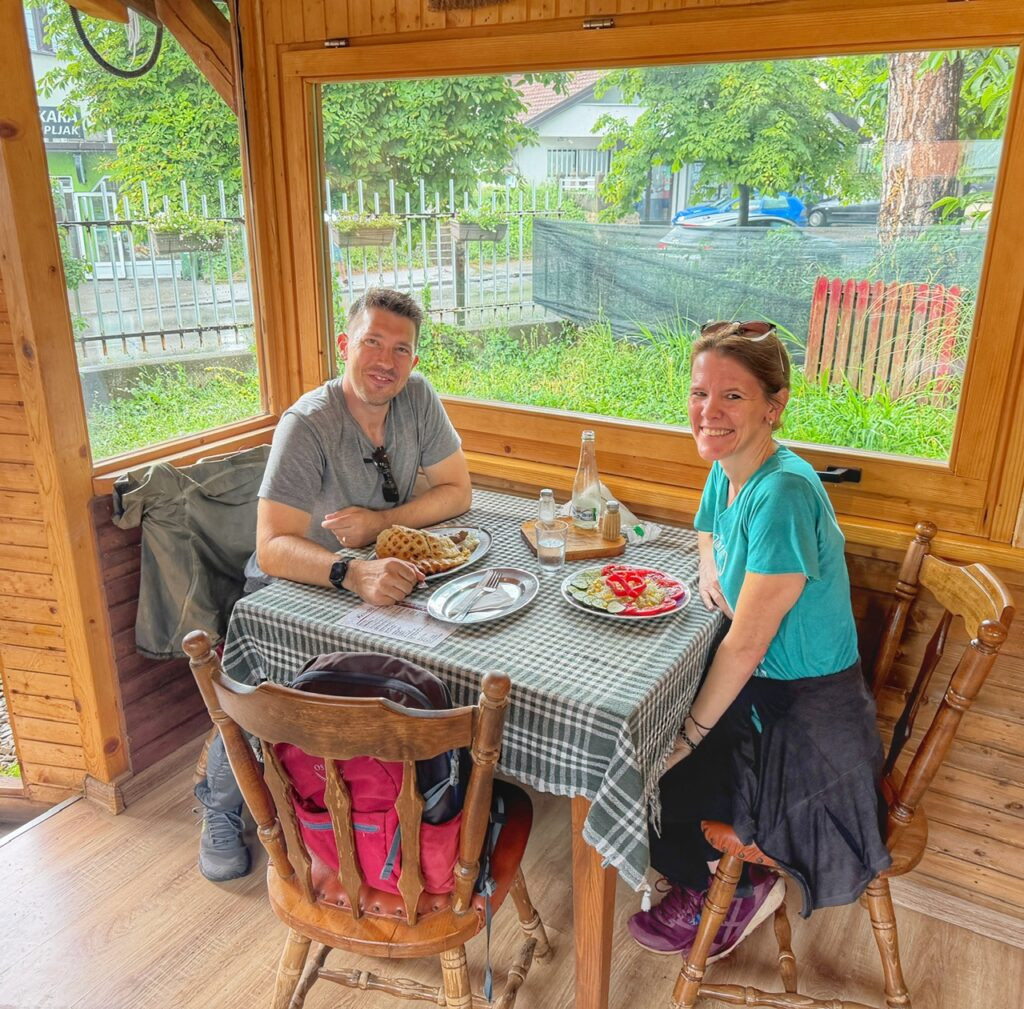

After sloshing through the rain for a good five minutes, we gratefully arrived to our lunch spot at Čevabdžinica Krivdić which Chat had recommended as the “best cevapi in Visoko,” which Greg wanted to try one more time. My salad, which definitely did not fill my stomach.


And Greg’s Ćevapi, which I encouragingly commented looked the same going in as it will coming out. I did have a sample, just to confirm I still didn’t like it. He thought it was ok, but nothing special, which was also our consensus in 2019 after multiple tries. In short, we’re done with ćevapi.
The two meals cost a budget-friendly $9 total, at least, and were served to us by the incredibly sweet proprietors pictured. They even let us wait out the rain, which had turned torrential including hail and sideways liquid.

With no end in sight, we unfortunately decided to bag the 35-minute one-way walk to the tunnels and head to the bus station for an overpriced journey back to Sarajevo. So we’ll never know if they would have had a more profound effect….
See ya later Great Pyramid!


